

Federated AI Approach Instead of a One-Size-Fits-All Model: Zoom and NVIDIA Redefine Enterprise AI Deployment
TL;DR: Zoom and NVIDIA are redefining the technical foundation of enterprise AI. At its core lies a federated architecture that intelligently combines specialized language models, powerful reasoning models, and GPU-accelerated infrastructure… Zoom …
TL;DR: Zoom and NVIDIA are redefining the technical foundation of enterprise AI. At its core lies a federated architecture that intelligently combines specialized language models, powerful reasoning models, and GPU-accelerated infrastructure…
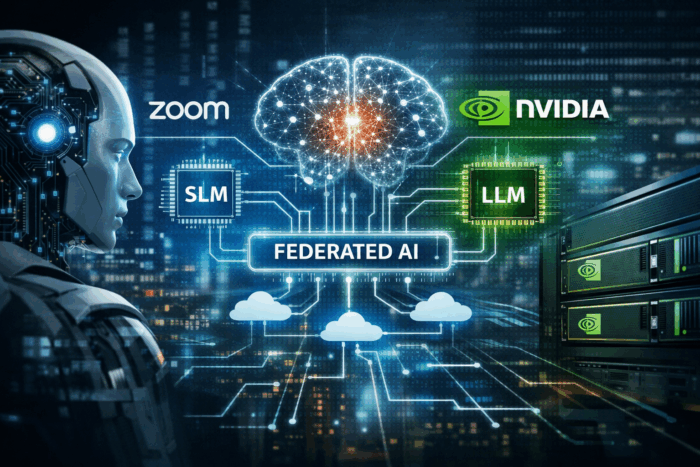
Zoom and NVIDIA are redefining the technical foundation of enterprise AI. Central to this shift is a federated architecture that intelligently combines specialized language models, high-performance reasoning models, and GPU-accelerated infrastructure. The goal: lower latency, controlled costs, and scalable AI capabilities for regulated enterprise environments.
With the expansion of its AI Companion platform, Zoom makes a clear break from monolithic AI stacks. Rather than relying on a single large language model (LLM) for all tasks, Zoom will now orchestrate multiple model classes within a federated architecture. Each user request is dynamically routed to the model best suited – technically and operationally – to fulfill that specific requirement.
Simple, latency-sensitive tasks – such as transcription, translation, or summarization – run on proprietary small language models (SLMs). More complex tasks demanding higher reasoning capabilities are delegated to a fine-tuned large language model.
NVIDIA Nemotron as the Foundation
The cornerstone of this expansion is the integration of NVIDIA’s open-source Nemotron technology. Zoom leverages it as the foundation for its own 49-billion-parameter LLM, built using NVIDIA’s NeMo tools. The emphasis is not on maximizing model size, but on achieving a technically optimized balance among accuracy, computational demand, and cost.
Thanks to this open architecture, Zoom can dynamically integrate both proprietary models and third-party AI services. For enterprises, this translates into greater technological independence – and the flexibility to adapt AI workloads to regulatory, economic, or operational requirements.
GPU Acceleration and Reduced Latency
A key technical enabler is deep integration with NVIDIA’s GPU and software stack. Accelerating inference processes significantly reduces AI Companion response times. At the same time, development cycles shorten, enabling faster time-to-market for new features.
Low latency is especially critical in collaborative scenarios such as meetings or live chats. The new architecture tackles this challenge systemically – not only at the application layer, but directly within the AI core.
RAG and Enterprise System Integration
Another technical priority is retrieval-augmented generation (RAG). The new architecture accelerates access to external knowledge sources and business systems. AI Companion can contextually process content from platforms like Microsoft 365, Google Workspace, Slack, Salesforce, or ServiceNow – without permanently replicating data. This shifts AI usage away from isolated assistant functions toward an integrated work layer that respects and complements existing system landscapes.
Importantly, the federated architecture is explicitly designed for industries with stringent compliance requirements. Financial services, healthcare, and public administration benefit from the fact that sensitive data need not flow indiscriminately into external models. Instead, the architecture makes granular, real-time decisions about where and how data are processed. Technically, Zoom positions itself clearly for scenarios where data privacy, data sovereignty, and controllable AI workflows matter more than maximum model size.
A Paradigm Shift in Enterprise AI Adoption
The collaboration between Zoom and NVIDIA signals where enterprise AI is headed: away from the all-in-one model, toward modular, governable, and performance-optimized architectures. Zoom’s federated AI approach thus becomes a central design principle for scalable, responsible AI in the enterprise.
Header Image Source: Cloudmagazin / AI-generated
Translated from the German original using artificial intelligence. The German version is authoritative.
Frequently Asked Questions
What’s key about NVIDIA Nemotron as the foundation?
The core of this expansion is the integration of NVIDIA’s open-source Nemotron technology. Zoom uses it as the foundation for its own 49-billion-parameter LLM, developed with NVIDIA’s NeMo tools. The focus is not on maximizing model size, but on achieving a technically optimized balance among accuracy, computational demand, and cost.
What’s key about GPU acceleration and reduced latency?
A major technical lever is deep integration with NVIDIA’s GPU and software stack. Accelerating inference processes noticeably lowers AI Companion response times. At the same time, development cycles shorten, since new features reach market readiness faster.
What’s key about RAG and enterprise system integration?
Another technical priority is retrieval-augmented generation (RAG). The new architecture accelerates access to external knowledge sources and business systems. AI Companion can contextually process content from platforms like Microsoft 365, Google Workspace, Slack, Salesforce, or ServiceNow – without permanently replicating data.


