

AWS and Nvidia: GPU Surge Forces Platform Teams to Adapt
AWS, Microsoft, and Google are deploying Vera-Rubin and Blackwell GPUs. Here's what platform teams should budget for now, and which inference strategy is…
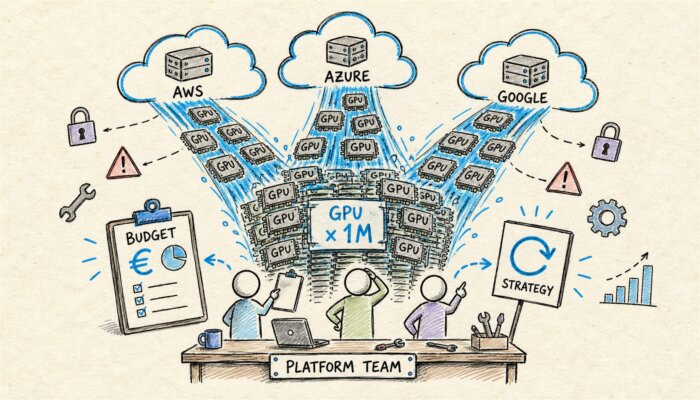
AWS and Nvidia announced an expanded partnership on 21 May: more than one million Blackwell and Rubin GPUs will be available across AWS regions from 2026. Meanwhile, Microsoft is building Vera Rubin NVL72 racks for the next Fairwater generation. This reshapes what platform teams must budget for over the next twelve months.
Key Takeaways
- One million GPUs are availability, not a bargain: More hardware backbone reduces spot shortages and region lotteries, yet on-demand pricing for Blackwell and Rubin in 2026 will still sit in the premium tier. Teams without reserved or capacity-block strategies will foot the bill for the wave.
- Vera Rubin NVL72 pushes multi-cloud hardware closer together: Microsoft for Fairwater, AWS for its own regions, Google Cloud and OCI according to Nvidia as well. Lambda, Crusoe, CoreWeave and Nebius join from Q1. Multi-cloud architectures can now align to a single hardware generation instead of three.
- Inference, not training, remains the costly block: The FinOps Foundation places 80–90 % of AI spend on inference. The new cards shift performance metrics, not the cost problem, which hinges on utilization, routing and model choice.
RelatedFinOps for AI inference / Platform engineering becomes the production path
What AWS and Nvidia have actually committed
At the heart of the 21 May announcement are three concrete commitments. First, AWS will deliver more than one million Nvidia Blackwell- and Rubin-generation GPUs into its own regions by 2026. This is not a pre-order; it is an availability pledge to large AWS customers whose inference workloads have repeatedly hit capacity ceilings.
Second, Amazon EC2 will be the first major cloud to receive the Nvidia RTX PRO 4500 Blackwell Server Edition—the inference variant below the H100/H200 and upcoming GB200 class. It delivers lower absolute performance but a far better throughput-to-price-per-token ratio, precisely the card that bottlenecks production inference with large models today.
Third, Vera Rubin NVL72 is confirmed as a rack-scale system. Microsoft has committed to integrate it into the next Fairwater sites; AWS, Google Cloud and Oracle Cloud are listed as launch cloud partners. Joining them are specialist AI cloud providers CoreWeave, Lambda, Nebius and Nscale, who no longer compete solely on spot pricing but on hardware parity with the same wave.
Vera Rubin rewires multi-cloud hardware logic
Until now, multi-cloud AI workloads meant juggling three very different hardware generations: AWS Trainium and Inferentia in one world, Google TPUs in another, Microsoft mixing Nvidia and its own Maia accelerators. Teams distributing models across clouds effectively ran three tuning pipelines in parallel—one for each compiler toolchain and quantization stack.
With the Vera Rubin wave, that changes for a subset of workloads. Three of the four hyperscalers are rolling out the same Nvidia generation. Same CUDA version, same TensorRT-LLM pipelines, same NCCL topology at the NVL72 rack level. Platform teams that have spent two years stitching cross-cloud inference pipelines finally gain a consistent hardware layer.
This does not make multi-cloud AI suddenly trivial. Inter-region latency, data-sovereignty and egress charges remain the same pain points. Yet the argument that migration is impossible because hardware profiles differ loses much of its force.
What the Hardware Wave Promises in Numbers—and What It Doesn’t
The FinOps Foundation’s State-of-FinOps-2026 report confirms what practitioners have known for months: 73 percent of surveyed organizations report AI costs exceeding budget, with the average enterprise AI budget rising from 1.2 million US dollars in 2024 to about 7 million in 2026. Meanwhile, 98 percent of FinOps teams now actively manage AI spend—up from 31 percent two years ago.
The latest hardware wave addresses part of this challenge. Google claims Trillium delivers up to 1.4× higher inference performance per dollar compared to its predecessor. Rubin and Blackwell Ultra are playing in the same league. Yet these efficiency gains vanish if GPU utilization in production hovers between 15 and 30 percent—a typical figure cited by the Foundation. Faster cards running half-empty are more expensive, not cheaper.
The second blind spot is lead times. A million GPUs spread over the year sounds plentiful, but at current growth rates for inference workloads—even without new large-scale generative use cases—supply is already tight.
Three Takeaways Before Your Next Inference Commit
- Recalculate Capacity Blocks and Reserved Instances. If you’re eyeing Blackwell or Rubin, don’t cover the next twelve months with on-demand. Spot availability will improve short-term, but on-demand remains the priciest option. AWS Capacity Blocks and Nvidia DGX Cloud Lepton are the two routes gaining traction among enterprise customers right now.
- Build—not just plan—inference routing across clouds. With consistent hardware generations, investing in a router that picks AWS, Google, or Microsoft based on latency, price, and utilization starts to pay off. Tools like LiteLLM, vLLM Production Stack, and Bedrock Cross-Region Inference have matured rapidly in recent months.
- Treat model selection as a FinOps lever. The Foundation still ranks model size and quantization as the top cost lever, ahead of hardware generation. A well-quantized 70B model on RTX PRO 4500 can cost less per token than an unoptimized 70B model on an H100. The hardware wave makes this decision more—not less—critical.
Frequently Asked Questions
Does a million GPUs mean that shortages will disappear by 2026?
Not automatically. The figure covers AWS’s entire hyperscale fleet across the year. Which region receives which generation when is not public. If you’re planning critical workloads, secure capacity via Capacity Blocks or Reserved Instances—otherwise you’ll remain in lottery mode.
Is switching from H100 to Blackwell for inference already worthwhile today?
For large-model inference, usually yes; for mid-size models, not necessarily. The jump in tokens per second is significant with very large contexts, but often irrelevant for smaller workloads. Benchmark your actual application before any migration—“new is better” rarely holds up in practice.
What does the wave mean for DACH sovereignty projects?
European providers—OVHcloud, IONOS, Open Telekom Cloud, plusserver—will receive Vera Rubin hardware later and in smaller volumes than the hyperscalers. If you must keep inference workloads in EU-sovereign environments for regulatory reasons, check roadmaps early and plan hybrid strategies: train in EU-sovereign, infer in public cloud, cleanly separated.
What role will the neoclouds—Lambda, CoreWeave, Crusoe—play?
They’re the wildcard. With the same hardware generation, far more aggressive pricing, and less overhead, by 2026 they’re a serious contender for pure inference workloads lacking data-sovereignty arguments. In practice, we see multi-provider setups where a hyperscaler handles the regulation-sensitive part and a neocloud handles the scaling burst.
What happens to proprietary accelerators—Trainium, TPU, Maia?
They’re not going away. AWS Trainium 2 and Google TPU v7 remain in the portfolio; for training they still cost fewer tokens per dollar than Nvidia equivalents. Yet in mainstream inference, Nvidia with Vera Rubin will dominate across clouds. Locking in on a single accelerator in 2026 carries greater risk than multi-vendor complexity.
More from the MBF Media Network
- Digital ChiefsPost-Quantum Cryptography: The Countdown for Corporate IT Has Begun
- MyBusinessFutureGartner: 2.52 Trillion US-Dollar AI Spending by 2026
- SecurityTodayMachine Identities: The Accounts Nobody Counts
Image source: AI-generated (May 2026), C2PA certificate on file.
Translated from the German original using artificial intelligence. The German version is authoritative.


