

Edge Computing Logistics: 5 Building Blocks for Real-Time Operations
Edge in the supply chain starts with architecture: 5 building blocks that enable real-time performance under 10 ms, from K3s to private 5G.
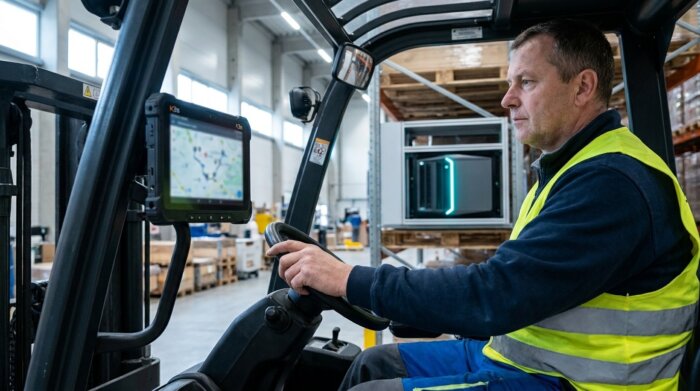
A forklift that calculates its route only after waiting for a response from a data center 600 kilometres away will always arrive too late. Real-time in the supply chain starts with one question: which decision gets made where. Anyone planning edge computing in logistics sets the architecture first, the tooling second, and the presentation last.
Key Takeaways
- Latency is an architecture decision: For deterministic control under ten milliseconds, the edge remains the only viable option in around 70 percent of industrial IoT use cases. A centralised cloud cannot reclaim that latency budget in practice.
- Lightweight Kubernetes is a requirement, not a preference: K3s, KubeEdge, and MicroK8s replace the full cluster on-site. 67 percent of companies plan edge investments in 2026, with K3s leading the way.
- The cost driver sits in operations: Edge nodes across 40 warehouse locations are not a cloud contract – they are 40 small data centres, each with its own patching, monitoring, and liability requirements.
Related:FinOps sees everything but can’t touch anything / How quantisation cuts GPU costs
Why real-time in the supply chain becomes an architecture question
Definitions first, practice second. What is edge computing in logistics? It refers to processing data directly where it is generated: at the conveyor belt, the gate, the vehicle, the scanner. Instead of sending every sensor reading to a central cloud and waiting for a response, time-critical evaluation runs on a local compute node. The cloud handles whatever can afford to wait.
The reason is physics, not fashion. An autonomous industrial vehicle, a quality camera on a packaging line, or a sorter redirecting parcels by the second all need responses in single-digit milliseconds. For exactly this class of control tasks, the edge is the only viable answer in the majority of industrial cases. The round-trip time to a remote data centre alone consumes the entire latency budget before the application has even begun to compute.
That is the theory. In practice, edge projects rarely fail on concept – they fail on five concrete decisions. The building blocks below highlight the points where planning and operations must converge early.
1. Place the node where the decision is made
The first question is never which cloud, but where the compute node sits. An edge node belongs at the point where the time-critical decision is made – not at the nearest regional office with a server rack. For one logistics operator, that meant a compact node per hall, directly on the machine network, rather than a central server serving three sites.
The consequence is uncomfortable. Anyone who wants real-time must decentralise hardware, and decentralised hardware needs to be maintained. That is the trade-off pilot projects tend to overlook: one node in a demo is a laptop under a table. Forty nodes in production are a fleet.
2. Lightweight Kubernetes instead of full clusters
At the edge, nobody has room for a classic Kubernetes cluster with three control-plane nodes and a dedicated operations team. The standard answer in 2026 is: stripped-down distributions. K3s, MicroK8s, and KubeEdge bring orchestration to devices that were previously too small for it. That 67 percent of companies are planning investments in edge and K3s this year is not hype – it is the result of this technical maturity.
The three options solve different problems. Making the right choice upfront saves you a migration down the road.
| Distribution | Strength | Best for |
|---|---|---|
| K3s | Single binary, low memory footprint | Sites with their own stable connectivity |
| KubeEdge | Connects small devices as pseudo-nodes, offline-tolerant | Distributed sensor deployments with unreliable connections |
| MicroK8s | Close to standard Kubernetes, easy add-ons | Teams that already have Kubernetes expertise |
The honest rule of thumb: KubeEdge pays off when the connection drops regularly and the site still needs to keep running. If the link is stable, K3s is the simpler choice. Reversing that logic means building in complexity you will never need.
3. 5G must make the wireless link reliable
5G appears in many edge concepts, often without an operating model behind it. It only becomes useful in a concrete network: a private 5G network on a factory or warehouse site keeps latency below critical thresholds and gives the wireless link a reliability that open Wi-Fi in a hall full of metal rarely achieves. The edge computes; 5G transports deterministically to and from it.
The point that often gets missed in planning: a private 5G network is an infrastructure project with its own frequency planning, its own hardware, and its own operations. It does not replace a solid edge architecture – it complements it. Anyone selling 5G as a shortcut has forgotten to factor in the RF engineer.
4. Drawing the line: what stays at the edge, what goes to the cloud
Edge and cloud are not an either-or. The costly decision is where to draw the boundary between them. What stays at the edge is everything that must trigger an immediate action: sorting, collision avoidance, real-time quality rejection. What goes to the cloud is everything that can wait and depends on the full picture: trend analysis across all sites, model training, management reporting.
This separation has a consequence that leads directly to the data privacy question: if time-critical processing stays local, sensitive raw data never leaves the site at all. What does go to the cloud is often already aggregated. That is not a side effect – it is an architectural argument worth documenting deliberately, before the first audit question arrives.
5. The Costs Nobody Budgets For
The most uncomfortable piece comes last. A cloud service generates one invoice per month. Forty edge nodes mean forty sets of hardware, forty patch cycles, forty physical security requirements, and forty potential points of failure. The logistics automation market is growing at around 14 percent annually, and a good portion of that growth lands as operational expenditure – not a one-time capital purchase.
Anyone planning edge is planning a distributed data center. That reality needs to be put on the table honestly before you start: centralized management via the Kubernetes layer, automated rollouts instead of manual work at every site, monitoring that flags a dead node before the warehouse grinds to a halt. Cost control needs to be given a mandate from day one, not treated as a cleanup operation after the fact. I’ve pushed that too far down the road too many times.
Frequently Asked Questions
What is edge computing in logistics?
It is the processing of data directly at its point of origin – at the conveyor belt, gate, or vehicle – rather than sending every value to a central cloud. Time-critical computations run locally on an edge node; the cloud handles whatever can afford to wait. The goal is deterministic real-time performance for control tasks.
Why isn’t a central cloud sufficient for real-time processing?
Control tasks such as sorting or collision avoidance require responses in single-digit milliseconds. The round-trip latency to a remote data center often consumes that entire budget before the application has even started computing. For around 70 percent of industrial IoT use cases, the edge therefore remains the only viable option.
Which Kubernetes distribution is suited for the edge?
K3s works well for sites with stable connectivity, KubeEdge for distributed sensor environments with unreliable links and offline requirements, and MicroK8s for teams that already have Kubernetes expertise. The decisive factor is how frequently the connection drops and whether the site must keep operating when it does.
What role does 5G play in logistics edge deployments?
A private 5G network keeps radio latency on-site below critical thresholds and is more reliable than open Wi-Fi in a hall full of metal. It does not replace an edge architecture, however – it complements one. As an infrastructure project in its own right, it brings its own frequency planning and operational overhead.
Where is the biggest cost driver in edge projects?
Operations. Every edge site is effectively a small data center with its own patching, monitoring, and security requirements. Hardware acquisition is a one-time expense; operational effort is ongoing. Centralised management via the Kubernetes layer and automated rollouts keep it under control.
Image source: Cover image AI-generated (May 2026), C2PA certificate embedded in image
Translated from the German original using artificial intelligence. The German version is authoritative.


