

If the AI Bill Blows Up the Cloud Budget
FinOps for AI workloads: Gemini's batch mode halves token prices, AWS Inferentia reduces GPU load. Multi-cloud strategies are cutting AI costs.
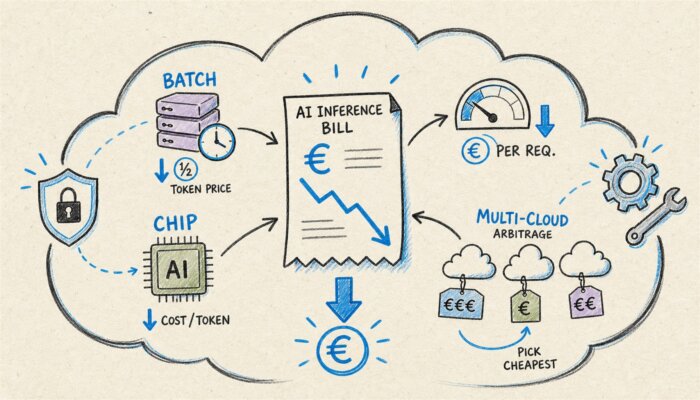
Inference is on track to become the single largest recurring cost block in AI operations, and according to the State of FinOps 2026, 98 percent of companies already manage AI spending through FinOps. Locking every inference workload to one provider means paying full list price. Multi-cloud isn’t a dogma-it’s a direct cost lever.
Key Takeaways
- Inference is the biggest line item: By 2026, ongoing model serving-not training-drives the AI bill. FinOps teams rank AI-workload cost management as the most-needed skill.
- Price per request varies by provider: AWS Inferentia2 undercuts comparable GPU instances by roughly a quarter, Google’s Gemini batch mode halves token cost, and context caching slashes up to 90 percent on recurring inputs.
- Multi-cloud only pays off with discipline: Without clean tagging, segregated workload types and an honest egress bill, complexity erodes every saving.
Related:FinOps sees everything but lacks authority / FP8, FP4 and vLLM: lowering GPU inference costs
Why the inference bill spirals out of control
Training is a one-off; inference is perpetual. Every query to a live model burns compute seconds, and with real usage, the pennies add up fast. That’s why the balance has shifted: by 2026, inference often accounts for the larger share of AI spend, outpacing one-time training costs.
The FinOps Foundation’s State of FinOps 2026 surveyed roughly 1,200 practitioners. The verdict is clear: 98 percent already govern AI spending through FinOps, and managing AI workload costs is the most-sought capability across all company sizes. The low-hanging waste lever is largely exhausted; what remains are many smaller, harder-to-grab savings-and provider choice is among the biggest.
What is FinOps? FinOps blends finance, technology and business to jointly govern cloud and AI spend. It’s not a cost-cutting tool but an operating discipline: who consumes which resource, what it costs, and what business value it delivers. Without that mapping, every cost discussion remains a guessing game.
Where the per-request price truly drops
There are three levers, and they operate at different levels. The first is hardware. AWS Inferentia2, the in-house inference chip, is roughly a quarter cheaper per hour than comparable GPU instances, and according to AWS delivers up to 40 percent better price-performance. The catch: the model must be compilable via the Neuron SDK. When it runs, the impact is significant; when it doesn’t, the chip isn’t an option.
The second lever is the operating mode on the model side. Using a hosted model like Google Gemini in batch mode for asynchronous load cuts the token price in half. Context caching slashes the cost of recurring inputs to about one-tenth, because the same context isn’t reprocessed every time. For document pipelines, overnight evaluations, or content workflows, this ranks among the biggest savings. Shrinking the models themselves-through quantization to FP8 or FP4, for example-further reduces load before you even pick a provider.
The third lever is commitment. Compute Savings Plans can slash on-demand prices by up to 72 percent, depending on term and upfront payment. For predictable base load, this is the obvious choice. Spot capacity is even cheaper, but it’s not viable as the sole foundation for production inference serving: a withdrawn instance means an interrupted request, and that’s unacceptable for live services.
Multi-cloud arbitrage: what holds up, what collapses
When the cheapest options are scattered across providers, multi-cloud becomes a cost argument rather than an ideology. The idea is simple: run each workload type where it costs the least. In practice, it only works if you know the counter-calculation.
What holds up
- Pick the cheapest provider for each workload type, separating steady and asynchronous load
- Gain more negotiating power because loads are distributed instead of bundled with one provider
- Capture batch and caching discounts that fit the right workloads
What collapses
- Egress fees on data transfers between clouds can eat up the savings
- Two stacks mean double the operational complexity and two skill sets
- The Neuron port ties you back to AWS, so the advantage isn’t a free switch
The honest verdict: arbitrage pays off for organizations with high, clearly separated inference loads. If you only send requests sporadically, a clean single-cloud setup with commitments is cheaper. A second stack that nobody maintains costs more than it saves.
The FinOps roadmap for AI workloads
A sober sequence can be derived from the levers. It doesn’t start with a tool, but with a convention.
It’s less spectacular than pitching a new model, but it’s the part that lands on the balance sheet. By 2026, FinOps for AI is no longer an elective-it’s the condition that turns an AI service into margin instead of just an invoice.
Frequently Asked Questions
What does FinOps mean for AI workloads?
FinOps applies cost-control principles from traditional cloud environments to AI spending: inference and GPU loads are mapped to specific models, teams, and use cases, assigned concrete costs, and weighed against their business value. According to the State of FinOps 2026, 98 percent of surveyed companies already do this, up from 31 percent two years ago.
Is AWS Inferentia worth it compared to GPUs?
Yes, if your model runs via the Neuron SDK: Inferentia2 instances are noticeably cheaper per hour depending on the comparison and, according to AWS, deliver up to 40 percent better price-performance. The catch is compilation support-models without Neuron compatibility remain on GPUs.
How much does Google Gemini’s batch mode save?
Batch mode cuts token prices in half for asynchronous, non-time-sensitive workloads. Context Caching further reduces recurring input costs to roughly one-tenth. Both measures only pay off when workloads are cleanly separated and no request is treated as real-time.
What extra costs come with multi-cloud?
Primarily egress fees for data moving between clouds and operational complexity: two stacks, two monitoring paths, two skill sets. These items must be included in the calculation before claiming arbitrage as savings. For small workloads, the overhead often outweighs the gain.
Are spot instances suitable for AI inference?
Generally not for production serving. Spot capacity is significantly cheaper, but can be withdrawn at any time; an interrupted instance means an interrupted response. Spot works for fault-tolerant batch jobs, but it’s risky for live inference.
More from the MBF Media Network
Image source: AI-generated (June 2026), C2PA certificate embedded in image
Translated from the German original using artificial intelligence. The German version is authoritative.


