

Coolify Review: Self-Hosting instead of Vercel and Heroku
Coolify in the practical test: What the self-hosted PaaS really delivers against Vercel and Heroku, what it costs, and for whom the switch is worthwhile.
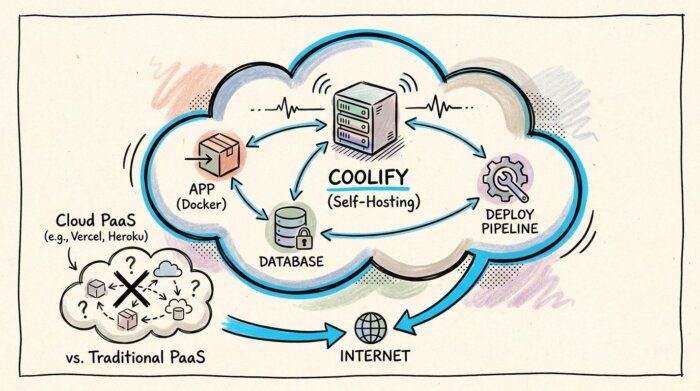
A small development team can easily rack up several hundred euros a month on a managed PaaS-often for bandwidth that would cost almost nothing on a European server. Coolify promises the same one-click deploy convenience on your own hardware, open-source and free of usage fees. In our test it delivers on that promise, but there’s a cost that never shows up on any invoice.
Key Takeaways
- Cost lever instead of toy: Coolify itself is free; you only pay for the server. A Hetzner server from around €5 per month can host several small applications that a managed provider would bill many times over.
- Convenience comes along, the operations stay with you: Git-push deploys, automatic TLS certificates and more than 280 one-click services work. Updates, backups and server maintenance, however, are now your responsibility.
- The bill doesn’t add up for the wrong people: Teams with basic Linux skills save significantly. Front-end-only crews without ops knowledge swap a cash invoice for a time invoice.
Related:AI sovereignty starts with open-source infrastructure / FinOps sees everything but isn’t allowed to act
Why teams are bringing their deploys back onto their own servers
For years, the convenience of big deploy platforms has become second nature: push code, wait a few minutes, and it’s live. Many teams accept a pricing model that scales with usage and hits hardest where control is thinnest-bandwidth is the classic example. A viral article or a major software update can inflate the bill without improving the product one bit.
That’s exactly where the counter-trend, known as cloud repatriation, steps in: workloads move from rented platforms back to controlled, often European infrastructure. The historic drawback was the loss of convenience; self-hosting used to mean stitching together reverse proxies, certificate management and deployment scripts. Coolify aims to rebuild that convenience without the platform invoice.
What is Coolify? Coolify is an open-source, self-hosted platform that brings the one-click deploy comfort of providers like Vercel or Heroku to your own server. It connects to a Git repository, builds a container image from the code, launches it and makes the application reachable under its own domain. The software itself is free; you only pay for the underlying server.
What Coolify Actually Does in Production
At its core, Coolify operates like a conductor for containers. You connect a repository from GitHub, GitLab, Gitea, or a self-hosted instance, select a build method, and let the software handle the rest. Options include Nixpacks for automatic detection of common languages, a custom Dockerfile, Docker Compose for multi-part applications, or a pure delivery mode for static sites. Coolify builds the image, launches the container, and terminates TLS encryption via the integrated reverse-proxy Traefik, complete with automatic Let’s Encrypt certificates.
Since the jump to version 4-marked stable in April 2026 after roughly two years in beta-the platform has matured. The feature set spans over 280 preconfigured services at the click of a button, from databases and analytics tools to full applications, and even database hosting with built-in backup routines. The May update to version 4.1 added a new build path called Railpack for environment variables at build time, plus structured audit logging for API changes, authentication events, and webhook activity. These are exactly the kinds of features that lift a platform out of the “tinkerer’s corner.”
Equally important is what Coolify still cannot do in this release. You can attach multiple servers and deploy applications to remote machines, yes. What’s missing is automatic cluster orchestration with high availability and load balancing across those servers. Teams that need genuine horizontal scaling with fault tolerance hit a wall that version 5 is supposed to tear down. For a single, well-provisioned server, that limitation is rarely a problem. For a team that tomorrow needs a resilient cluster, it’s a deal-breaker.
Who Benefits from Switching-and Who Doesn’t
The honest answer isn’t about technology; it’s about people. The cost advantage is real and substantial. A managed dyno runs about €23 per month per running process, a Pro seat clocks in at roughly €19 per user per month, and bandwidth charges for a European server are almost negligible. Real-world reports show teams cutting monthly bills from triple digits to low double digits simply by moving to their own hardware.
Offsetting that is a line item that never appears on any price sheet. Setting up a clean deployment pipeline with tests takes several hours of labor, and ongoing operations over the year another handful of days. That workload doesn’t vanish just because the monthly invoice disappears; it shifts from the credit card to your own team. If you have people who understand Linux and operations basics, you’re making a smart trade. If you hand the task to a pure front-end squad without server experience, you’re swapping predictable costs for unpredictable effort-and often tuition fees on top.
For mid-sized teams with their own IT, agencies juggling many small client projects, and anyone who wants to regain control over their infrastructure for sovereignty reasons, Coolify version 4 is now a serious option-not a weekend hack. For a start-up that must scale unpredictably in six months, a managed service remains the calmer choice. Teams with ops know-how should give version 4 a serious test before the next platform bill arrives.
Frequently Asked Questions
Is Coolify really free?
The software is open-source and can be used without any licensing fees. Costs only arise for the server it runs on, such as a cloud server starting at around five euros per month. A paid cloud version is also available, where the provider manages the Coolify infrastructure for you.
What prior knowledge does a team need?
Basic knowledge of Linux administration and server management is required. While deploying applications is straightforward, updates, backups, and server security remain your responsibility-unlike with fully managed services.
How does Coolify differ from Vercel or Heroku?
Vercel and Heroku are managed services where the provider handles infrastructure and operations, billing based on usage. Coolify delivers similar deployment convenience but on your own servers. The trade-off is the added operational effort and the absence of usage-based billing.
Can Coolify scale across multiple servers?
Multiple servers can be connected and used to deploy applications. What’s still missing in Version 4 is automatic cluster orchestration with high availability and load balancing, planned for Version 5. For many small to medium setups, a single well-specified server is often sufficient.
What types of applications can it run?
Static sites, full-stack applications, databases, and over 280 preconfigured services are supported with a single click. Builds can be automated, defined via a custom Dockerfile, or orchestrated using Docker Compose for multi-container setups.
Image source: AI-generated (Juni 2026), C2PA certificate embedded
Translated from the German original using artificial intelligence. The German version is authoritative.


