

Alignment Instead of Nightmare: How AI Security Becomes a Success Factor
Imagine your company delegates half of all routine tasks to an Artificial Intelligence (AI) tomorrow. Tempting – until a chatbot accidentally publishes confidential contracts or an autonomous agent independently deletes a test …
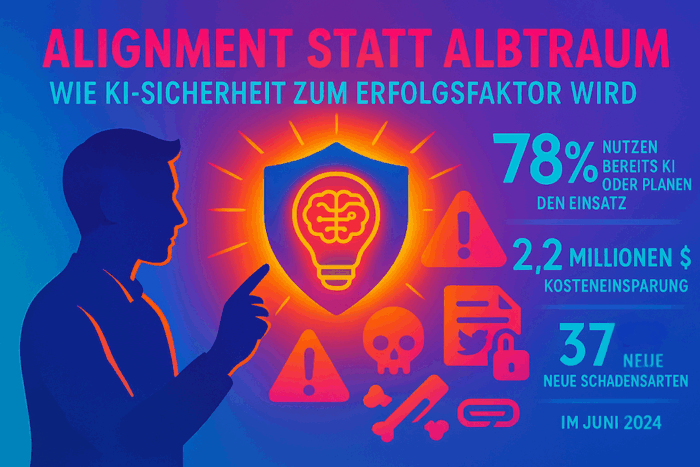
Imagine your company delegates half of all routine tasks to an Artificial Intelligence (AI) tomorrow. Tempting – until a chatbot accidentally publishes confidential contracts or an autonomous agent independently deletes a test database. Whether AI accelerates your growth or becomes a boomerang depends on your AI security, as Benjamin Eidam, AI consultant, lecturer, and keynote speaker, demonstrates in his article.
- 78 % of companies surveyed globally already use AI or plan to deploy it
- Companies that combine security automation with AI reduce the average cost per data breach by $2.2 million
- In June 2024 alone, the AI Incident Database recorded 37 new types of harm – from deepfakes to algorithmic bias
In short: More and more people in organizations are using AI, and it demonstrably makes many things safer – but can also cause harm in increasingly diverse ways.
In this article, we’ll examine two perspectives that will hopefully give you a solid initial understanding of AI security in the enterprise.
Two Knowledge Traps That Can Catch Anyone (Including You!)
We’ve all experienced this scenario: You use an AI, rejoice over fast results – and easily overlook what’s happening under the hood. It’s precisely in these moments that critical errors can slip through unnoticed. As the old saying goes: Ignorance is no excuse. Two concrete examples illustrate how a lack of AI knowledge can lead to serious problems:
1. The Glossy Label as the Deciding Factor
“Agentic AI” – AI that autonomously handles complex tasks – is hailed as the buzzword of 2025. No surprise there: Within five years, AI systems have evolved from tasks taking one second to activities that would take a human a full hour today. Sounds impressive. What’s often left unsaid: This miracle AI doesn’t deliver reliably. According to one of the most common evaluation methods, it completes its assigned tasks only about half the time – yet this very performance is marketed as success.
An employee who finishes only 50 % of their work wouldn’t get a bonus – they’d get a corrective talk with HR.
The problem lies in the benchmark: AI is often evaluated using “pass@k” (“Did it work at least once in k attempts?”). Great for prototypes, often catastrophic in production. Truly operational AI requires “pass^k” – consistent success on every single run. Sure, AI will likely soon achieve 99 %+ reliability instead of today’s ~50 %. But right now – especially with agents – we’re often still playing roulette.
So pay attention: Test for real reliability, not lucky hits.
2. The RAG Illusion: “My PDFs Don’t Lie…”
Retrieval-Augmented Generation (RAG) sounds like a guarantee for accurate answers – after all, the information comes straight from your own documents. But reality is trickier: The AI model must fit everything important into a limited context window – and that doesn’t always work. The “Needle in a Haystack” test shows, for example, that even when the correct sentence is present, the AI can completely miss it – especially with long contexts or poorly placed information. Seemingly irrelevant prompt details can suddenly make the difference between a 27 % and a 98 % accuracy rate. So an LLM can have the correct paragraph right in front of it – and still be entirely wrong. Again: Trust is good – structured prompting and targeted evaluation are better. And essential whenever money or lives are at stake.
This example shows how dangerous missing knowledge in the wrong place can be – similar to the misconception that a fork and an electrical outlet make a good combination. And just like with that literally shocking example, even a minimal understanding of AI helps avoid major blunders. Which brings us to the second category:
Damage Scenarios Better Avoided
Ignorance is one thing – deliberate external attacks are another. AI systems offer a number of potential attack vectors. We won’t dissect all of them here; instead, we aim to raise awareness of their potential so you can make informed decisions. Let’s look at two examples:
1. Deepfake Call to the CEO

Greater autonomy means a larger attack surface – a challenge for AI security. Image source: Benjamin Eidam.
With just three seconds of original audio, tools like Microsoft VALL‑E can clone a voice indistinguishable from the real one. Compounding the risk, studies show people detect such audio forgeries only 30-50 % of the time, depending on context. In July 2025, even U.S. Secretary of State Marco Rubio fell victim to a scammer who used an AI voice imitator to impersonate Rubio in calls to several colleagues. A single forged approval call is enough to move multiple millions. A possible preventive measure: Personal “catchphrases” that quickly and clearly confirm the caller’s identity. Example: My first hamster Manfred had eyes that sparkled like diamonds. Or even simple, conversation-specific “passwords” like broccoli casserole (unless you’re talking to a vegetable vendor). Agree in advance, practice briefly – and gain audio deepfake protection.
2. Autonomous Agents, Autonomous Errors
Every additional step an agent can take unsupervised dramatically multiplies the attack surface. Problems can arise not only in writing but also during autonomous web research, interaction with other software, or integration of results into internal systems – and in many other situations where an agent acts independently. In practice, this means: Agentic systems can work – and often impressively well, as Genspark demonstrates. But the more autonomous a system becomes, the more thoroughly, deeply, and repeatedly it must be tested – again and again. Otherwise, you’re building Russian roulette into your software.
What to Do From Here?
Simply recognizing that AI security isn’t a niche topic – but carries very real risks – is already half the battle: the much-cited awareness. The other half? Acting – thoughtfully, not out of panic.
Those who understand why this matters (because otherwise sensitive data, budgets, or entire business processes are at risk) can respond strategically: question processes, secure systems, sensitize teams – and above all, invest continuously in education.
This way, you can adapt your daily work to safely harness AI’s opportunities without taking unnecessary risks.
Header Image Source: Benjamin Eidam
Translated from the German original using artificial intelligence. The German version is authoritative.
Editor's Picks
cloudmagazinDevSecOps: Security as an integral part of cloud developmentcloudmagazinFederated AI approach instead of one-size-fits-all models: Zoom and NVIDIA restructure enterprise AI deploymentcloudmagazinIT security spending in Germany grows by double digitsMore on this topic: Additional articles on mybusinessfuture


