

How a Logistician Saved 31 Percent on Multi-Cloud Costs
How a logistician cut his multi-cloud bill by 31%: three quarters of FinOps discipline instead of a new vendor.
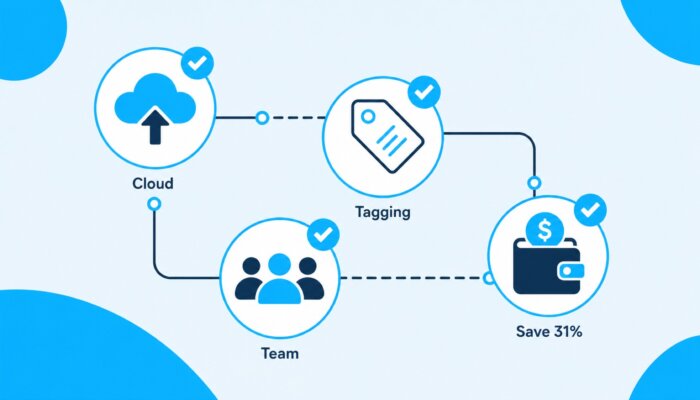
A logistics manager in North Rhine-Westphalia has reduced his multi-cloud bill by 31 percent. Not through a new vendor, not through a migration, but through three quarters of FinOps discipline, a team with real budget responsibility, and a tagging strategy that wouldn’t get a round of applause at any conference.
Key Takeaways
- Multi-cloud doesn’t pay for itself: Those who operate three hyperscalers in parallel without cost allocation at the workload level are primarily financing opacity. Contracts, reserved instances, and storage tiers otherwise cancel each other out.
- Cost intelligence is a team, not a tool: Tagging strategies rarely fail due to the software. They fail because no one is held accountable for which dimension receives funding and which does not.
- Logistics reveals the pressure earlier: Seasonal peaks and low margins do not allow for a FinOps middle ground. What shippers have to learn in weeks, other industries drag out for years.
Related:38% fewer cloud costs in manufacturing / FinOps Study 2026: Brokerage as the default path
Where the Multi-Cloud Bill Explodes
The logistics manager I’m talking about runs workloads on AWS, Azure, and a smaller European platform for regulated supplier data. Three contracts, three billing periods, three different tagging semantics. The bill ended 2024 at around 4.2 million euros per year, trending upward because more shipments produce more telemetry.
The problem wasn’t the price of individual instances. The problem was that no one could confidently say which department caused which share. Reserved instances were running out without anyone reacting. Storage in one region grew by six percent every month without anyone asking if the data class was still valid. A team ordered double compute capacity for a migration project for six weeks because the responsibility for shutting it down was not clear.
The concrete gaps in the current state were quantified: 27 percent of the running compute instances had no usable tag for cost center or product. 14 percent of the storage volumes had been lying unused for over 90 days in the most expensive tier. 1.9 million euros was the annual share of egress and cross-region costs that no one could assign to an application. These are not estimates; this was the starting point in the initial reports.
How the Cost-Intelligence Team Built Without a New Tool
The initial idea within the company was to purchase an additional tool. There are providers whose pitches in this segment are very good. The team evaluated two of them and ultimately decided against them. Not because the tools were bad, but because they did not address the core issue: Who decides within the company which dimensions are tagged.
Instead, they took three steps. First, a tagging policy was established on a page: four mandatory tags (Cost Center, Product, Environment, Owner), plus three optional ones for compliance workloads. Everything else was deleted. Anyone who wanted to create a new tag needed the approval of the finance liaison. Two-page documentation, approved by the CIO and accepted by the board.
Second, the collection account principle. A Cron job has been marking all resources without mandatory tags since the second quarter. After seven days, their costs are charged to an internal collection account managed by the platform team. Suddenly, the platform team had an incentive to contact the departments, rather than politely ask them.
Third, monthly cost reviews with owners, not with tools: each department sees their costs for the last 60 days in a one-sided PDF, segmented by product and region. No dashboard, no drill-down. Consciously reduced, because the conversation is more important than the visualization.
It may sound unspectacular. It is. The effectiveness lay not in the method, but in the fact that the method still existed after five months.
What Tagging Alone Does Not Solve
Tagging is the entry ticket. It brings transparency to the inventory, but it does little if the decisions about commitments and reservations remain in procurement, which does not know the workload. In our example, this was the second wave of reform: Reserved Instances and Savings Plans were transferred to the platform owners, not to central IT procurement. Reason: Who carries the technical risk should also be able to assess the commercial risk.
This had two effects. First, there was an honest discussion for the first time about which workloads are actually predictable and which are not. Second, Reserved Instances that a former buyer had extended for compliance reasons disappeared, even though the department had already retired the product.
This was one of those quiet wins that never appear in press releases. Saved amount: approximately 380,000 Euros per year. No new technology, no architecture change. Just someone who finally took responsibility.
The Three Trade-offs No One Openly Admits
Multi-Cloud FinOps is often sold as an efficiency program in many decks. In reality, it is a result of trade-offs that a company consciously accepts. Standardization versus speed is the first: Whoever centralizes tagging and commitment control slows down individual teams. Whoever wants speed accepts inefficiencies. There is no middle ground that delivers both. Anyone who promises it has never delivered it.
The second trade-off is tool coverage versus accountability. Specialized FinOps tools relieve the team, but they shift knowledge into the tool rather than into people’s heads. When the contract with the tool provider ends, cost intelligence is very quickly gone. The third: reserved commitment versus flexibility. A three-year savings plan saves money, but it tethers the company to an architecture assumption that may be wrong in three years. Anyone who aggressively pursues reservations should honestly calculate what an early termination costs.
These trade-offs cannot be automated away. A FinOps practice that openly admits them is much more sustainable than one that promises to deliver all three at once.
What Remains When the Hype Fades
FinOps has been the buzzword at every cloud conference for the past two years. Some of it is justified, but much of it is overhyped. What remains in practice, as exemplified by the logistics company, is surprisingly less methodical and surprisingly more organizational. An untouched tagging framework. A platform team that became the owner of untagged resources. Ownership of commitments. Monthly reviews with people, not just dashboards.
The result after three quarters: 31 percent lower multi-cloud costs, improved forecast accuracy, and a noticeably more sober discussion about new cloud initiatives. Now, when someone proposes a project, they must answer the question of who will bear the reserved commitment if the assumption does not hold. This question did not exist before.
Those hoping for a silver bullet will not find it here. Those who accept that cost intelligence is primarily a matter of responsibility have a realistic path forward.
Frequently Asked Questions
When does a dedicated FinOps tool become more cost-effective than using built-in tools?
A dedicated FinOps tool becomes more cost-effective when three conditions are met: using more than two hyperscalers, having more than 50 responsible owners, and maintaining a cloud budget exceeding approximately five million Euros annually. Below this threshold, the native cost explorers and a disciplined tagging approach are generally more economical and sustainable.
How quickly can a tagging strategy show results?
The first measurable savings can be observed after eight to twelve weeks, as the consolidated account model compels platform owners to quickly assign untagged resources. Structural effects from Reserved Instances and storage classes typically appear after two to three quarters.
Who should be responsible for Reserved Instances?
The responsibility should lie with the platform or product owners who are technically familiar with the workload. A central IT procurement without workload context often takes a defensive stance and extends contracts with unused parts, which is the most expensive mistake in practice.
How many mandatory tags are sensible?
For most corporations, four to five mandatory tags are sufficient. More tags can lead to gaps because no one consistently maintains all fields. Cost center, product, environment, and owner are typically sensible, plus one for compliance class if regulated workloads are involved.
What about egress and cross-region costs?
Egress costs are the most inconvenient to manage because they often involve two owners: the sending and receiving systems. The practical solution is to charge egress to the sending workload and explicitly list it as a separate line item in monthly reviews. Otherwise, it disappears as an invisible entry in the overall budget.
More from the MBF Media Network
MyBusinessFutureCrisis Plan Instead of Crisis PR: Four Decisions for SMEsDigital ChiefsSenior Tech Talent 2026: The New Interface ProfileSecurityTodayAI Voice Clones: How DACH Companies Can Protect Themselves in 2026Image source: AI-generated (May 2026), C2PA certificate embedded in the image
Translated from the German original using artificial intelligence. The German version is authoritative.


