

Cloud-native matures: What Knative and Kubernetes 1.34 mean for AI workloads
Knative has graduated, and Kubernetes 1.34 brings production-ready AI hardware scheduling to life-here’s what the latest cloud-native maturity means for…
7 min read
Two signals from the cloud-native world point in the same direction: the CNCF has promoted Knative to Graduated status, and Kubernetes 1.34 makes AI and ML hardware scheduling production-ready. Both may sound like platform-team minutiae, but together they signal something bigger: serverless and AI workloads now run on mature, vendor-neutral infrastructure. For DACH teams, the question shifts from *if* to *how*.
Key Takeaways
- Knative graduates. Serverless on Kubernetes is now considered mature and production-proven.
- Kubernetes 1.34 brings AI into regular operations. AI and ML hardware scheduling becomes production-ready, alongside stronger supply-chain security.
- Vendor-neutral. Both components run in your own cluster, without locking you into a hyperscaler service.
Related:VMware VCF 9.1 and the sovereignty question / FinOps and cloud waste
What Knative’s graduation means
What is Knative? Knative is an open-source layer on Kubernetes that enables serverless, event-driven applications. It handles scaling, routing, and event processing, so developers don’t need to manage the underlying infrastructure. Code scales down to zero when idle and automatically scales up under load.
The CNCF’s Graduated status isn’t a marketing badge–it’s a maturity signal. It means a project has a broad user base, stable governance, and proven production readiness. For a platform team evaluating technology, that’s the difference between an experiment and a reliable foundation. Running serverless with Knative is no longer a gamble.
The real appeal lies in independence. Until now, serverless was mostly a hyperscaler service, with the usual trade-off: build your functions there, and you’re locked into one provider and their pricing model. Knative brings the same experience into your own Kubernetes cluster. Applications scale to zero when demand is low, and operations stay in-house. For regulated DACH industries, that’s a game-changer.
Why Kubernetes 1.34 Matters for AI Workloads
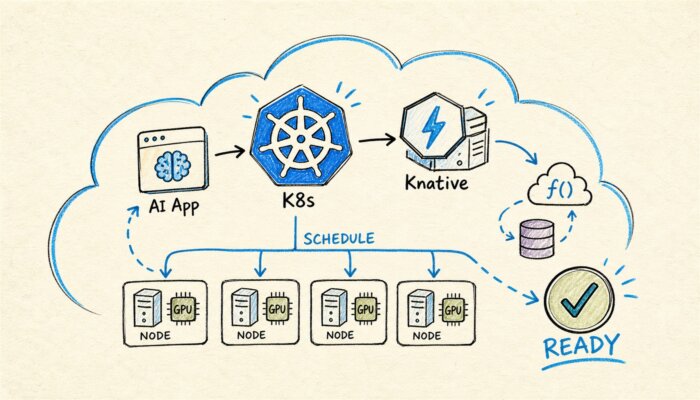
For a long time, Kubernetes was only marginally suited for GPU-intensive AI workloads. Scheduling specialized hardware was cumbersome, and resource allocation was coarse. Version 1.34 changes that with production-ready dynamic resource allocation. In other words: the cluster can now distribute GPUs and other accelerators precisely and reliably to the workloads that need them. This is the prerequisite for running AI training and inference cost-effectively on your own platform.
On top of that, supply chain security has been hardened. In an era where attacks via manipulated packages and images are on the rise, this is no sideshow. A cluster that enforces signed artifacts and verifies the origin of its components closes the very entry point that many recent incidents exploit. Maturity here doesn’t just mean more features–it means a smaller attack surface.
What to Consider
- Self-hosting demands platform expertise
- More components, more maintenance
- Maturity doesn’t automatically mean simplicity
What It Delivers
- Serverless and AI without hyperscaler lock-in
- Data sovereignty within your own cluster
- Scaling to zero cuts idle costs
How DACH Teams Can Leverage This
The honest assessment: maturity reduces risk, but it doesn’t eliminate the work. A team aiming to run Knative and AI scheduling in their own cluster needs platform expertise. If that expertise isn’t already in place–or isn’t a priority to build–a managed service might still be the better option. Graduation makes self-hosting viable, but it doesn’t make it effortless.
So, who stands to benefit? Primarily organizations with two key traits: a serious need for data sovereignty and a team already running Kubernetes. For them, the hurdle has always been that serverless and AI scheduling on their own platform felt immature. That hurdle is now gone. The decision shifts from whether the technology can support the workload to whether the team is ready to take it on.
The takeaway is clear. Cloud-native has reached a point where serious AI and serverless workloads no longer *have* to live in the public cloud. For DACH, this is good news–it aligns data sovereignty with cost efficiency. But it’s also a call to honestly assess your own platform expertise. The technology is ready. The question is whether your organization is.
Frequently Asked Questions
What does Graduated status mean at the CNCF?
It is the highest maturity level of the Cloud Native Computing Foundation. It requires a broad user base, stable governance, and proven production readiness. For evaluations, this marks the transition from experimentation to a reliable foundation.
What does Knative offer compared to hyperscaler serverless?
It offers the same operational model, but within your own Kubernetes cluster and without vendor lock-in. Applications scale down to zero, while operations remain in-house. This is particularly relevant for industries with strict data sovereignty requirements.
Why is Kubernetes 1.34 important for AI?
Production-ready dynamic resource allocation allows GPUs and accelerators to be distributed to workloads with fine-grained precision and reliability. This is the prerequisite for running AI training and inference economically on your own platform.
Is self-hosting easier now?
More viable, but not effortless. Maturity reduces risk, but still demands platform expertise. Teams lacking this expertise might be better off with a managed service.
Who benefits from taking this step?
Organizations with serious data sovereignty needs and a team that already runs Kubernetes. For them, the previous hurdle of immaturity is gone, making the decision purely a question of internal capacity.
Image source: AI-generated (June 2026), C2PA certificate embedded in the image
Translated from the German original using artificial intelligence. The German version is authoritative.


