

VMware Cloud Foundation 9.1: AI workloads and the sovereignty question in your own data center
VMware Cloud Foundation 9.1 brings AI workloads in-house to your data center: GPU support, 500-node clusters, and sovereignty-why the licensing deal…
7 min read
VMware Cloud Foundation 9.1 is now available, with a clear focus: AI workloads in your own data center instead of the public cloud. With support for the latest NVIDIA and AMD accelerators, Kubernetes management for up to 500 clusters, and built-in sovereignty features, this release directly addresses the DACH region’s critical question–who actually retains control over the data. The catch lies in the licensing agreement.
Key Takeaways
- Private AI gets real. ESX 9.1 supports NVIDIA ConnectX-7, BlueField-3, and AMD MI350–AI training in your own data center is now practical.
- Sovereignty is built in. Data residency controls and TPM-backed security hit the mark for regulated DACH industries.
- The bill hides in the contract. VCF 9.1 delivers technically, but the real trade-off is Broadcom’s licensing model.
Related:800-volt DC for AI racks / Data center energy efficiency and the EnEfG
What VCF 9.1 delivers technically
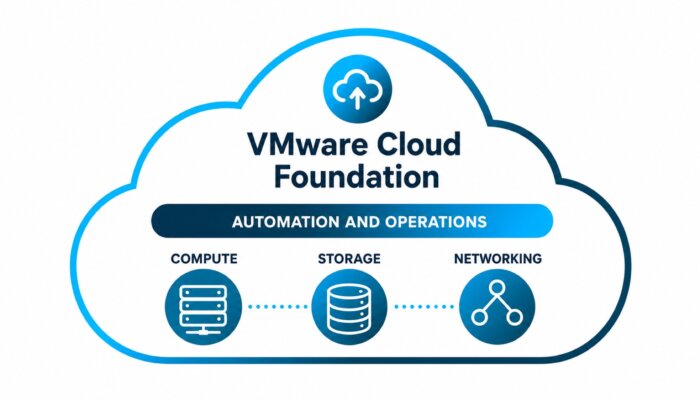
What is VMware Cloud Foundation? VCF is an integrated platform that bundles compute, storage, networking, and management into a private cloud. It runs in your own data center and manages virtual machines, containers, and Kubernetes through a unified control plane. Version 9.1 has been available since May.
The most exciting updates lie where AI meets infrastructure. ESX 9.1 now supports NVIDIA’s ConnectX-7 and BlueField-3 with Enhanced DirectPath, as well as the AMD MI350 as an accelerator. In plain terms: the hardware needed for AI training can now be passed through with near-native performance–a long-standing weak spot in virtualized environments. VMware has closed that gap.
On the Kubernetes side, the platform manages up to 500 clusters via a single control plane, with significantly faster provisioning thanks to linked-clone technology. Virtual machines, containers, and Kubernetes run side by side under the same management layer. Memory tiering also comes into play, using NVMe SSDs as a secondary storage layer to boost VM density and reduce total cost of ownership. These aren’t just marketing claims–they’re the levers ops teams will feel in day-to-day operations.
Why This Is a Sovereignty Issue in DACH
The real game-changer for operators in Germany, Austria, and Switzerland isn’t GPU support–it’s sovereignty features. VCF 9.1 introduces data residency controls and TPM-backed security. For regulated industries–from banking and insurance to healthcare–this is the prerequisite for running AI on sensitive data at all.
The public cloud remains a gray area for many of these workloads. If you send patient records or credit files through an AI model, you need to know where the data resides and who has legal access. A private platform with built-in residency controls shifts this question from an act of trust to a technical setting. That’s exactly what NIS2, DORA, and the EU AI Act demand in practice.
This positions VCF as the answer to a question keeping many DACH companies up at night: How do I run AI without losing control of my data? The platform provides the technical foundation. But it doesn’t make the strategic decision for you–what belongs in-house and what can stay in the public cloud.
The Trade-Off No One Talks About
Technically, VCF 9.1 is a strong release. The real conversation starts with the price. Since Broadcom’s acquisition, VMware’s licensing model has changed noticeably. Bundling, mandatory subscriptions, and higher costs have left many existing customers wondering whether to stay or migrate. If you’re planning VCF 9.1 as your private AI platform, you’re also signing up for this licensing model–not just the tech.
The math isn’t the same for everyone. A company with a large VMware footprint and regulatory pressure for data sovereignty will find VCF 9.1 the obvious solution–because migration and sovereignty would cost more than the subscription. A mid-sized business without major existing investments might run the numbers differently and look at Kubernetes-native alternatives without the VMware stack underneath. Both paths are valid. The only mistake is buying the tech and treating licensing costs as a surprise.
What remains is a sober assessment: VCF 9.1 makes private AI infrastructure more mature and manageable than it was a year ago. It solves the sovereignty challenge convincingly on a technical level. But whether it’s the right choice depends not on the features, but on what your organization will pay for this stack in five years–and whether you’re willing to bear that cost.
Frequently Asked Questions
Is VCF 9.1 worth it for AI workloads in your own data center?
Technically, yes. With support for NVIDIA ConnectX-7, BlueField-3, and AMD MI350, plus Enhanced DirectPath, virtualized AI training becomes practical with near-native performance. However, the decision heavily depends on the licensing model.
What do the sovereignty features actually deliver?
Data residency controls and TPM-backed security enable AI operations on sensitive data without ceding storage location or access to external providers. This directly addresses requirements from NIS2, DORA, and the EU AI Act.
How many Kubernetes clusters does VCF 9.1 manage?
Up to 500 clusters via a single control plane, with provisioning up to 70 percent faster than the previous generation. Virtual machines, containers, and Kubernetes all run under the same management umbrella.
What’s the biggest catch?
The Broadcom licensing model. Bundling and mandatory subscriptions have driven up costs for many existing customers. If you’re planning VCF 9.1, calculate the total cost over five years–not just the technical benefits.
Are there alternatives without the VMware stack?
Yes. Kubernetes-native private cloud approaches without an underlying VMware stack are a viable option, especially for companies without a large legacy footprint. The effort then shifts from licensing to in-house platform expertise.
Image source: AI-generated (May 2026), C2PA certificate embedded in image


