

Cloud Repatriation: When It Makes Sense to Bring Back Data
86 percent of CIOs are moving workloads back from the public cloud. When repatriation makes sense and which loads are better left in the cloud.
7 min. read
More decision-makers than ever are planning the journey back. A Barclays survey from late 2024 recorded the highest level of repatriation intent among CIOs since tracking began. The reason is rarely ideological. It’s the numbers – bills that no longer add up after years of cloud migration. Add to that workloads that were never truly at home in the cloud.
Key Takeaways
- Repatriation has gone mainstream. More than four in five CIOs are planning workload repatriation according to the Barclays survey, and a significant share of once-migrated workloads is already back on-premises. The pendulum is swinging toward deliberate placement rather than cloud-by-default.
- The math only works for the right workloads. Predictable, sustained loads with constant demand can save a solid double-digit percentage on-premises. Variable, seasonal, or experimental workloads remain cheaper in the cloud.
- The return journey has its own costs. Hardware, operational know-how, and egress fees all come into play. Those who repatriate without a complete cost analysis often end up paying more for hardware and operations than the cloud bill ever would have cost.
Related:VMware Price Shock: DACH Companies Face a Hard Choice / Coolify Reviewed: Self-Hosting Instead of Vercel and Heroku
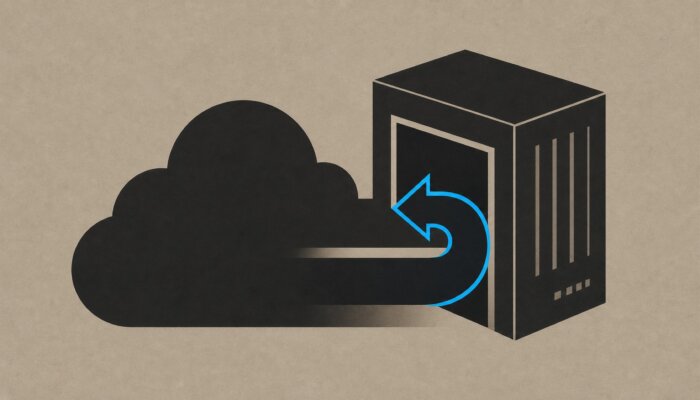
What is cloud repatriation? Cloud repatriation refers to the process of moving applications or data back from the public cloud into a private cloud or on-premises data center. It corrects placement: workloads land where they run most cost-effectively and with the greatest control across their lifecycle.
Why Repatriation Is Picking Up Speed Right Now
Three developments are converging. The first is a sober cost reckoning. Many workloads were lifted into the cloud years ago without anyone tracking consumption over time. Where demand stayed constant, usage-based billing has compounded into multiples of what dedicated hardware would have cost. The second is the AI wave: GPU-heavy inference running at consistently high utilisation is among the most expensive items on any cloud bill – and precisely where on-premises operation pays off fastest.
The third is licensing pressure. The VMware price shock following the Broadcom acquisition showed many organizations just how quickly the economics of a platform can shift when a vendor controls the terms. A similar concern is shaping the public cloud debate, even if the cost profile differs. IDC surveys show that a large majority of IT decision-makers are already repatriating at least portions of their workloads, or are planning to do so. Repatriation has moved from the exception to a standard option in the planning toolkit.
What pays off and what stays in the cloud
The decision hinges on the load profile, not gut feeling. A predictable, steady-state workload – a database with stable throughput or a production inference environment running at constant utilisation – often runs significantly cheaper on your own hardware. Vendor analyses such as Broadcom’s cite total cost savings of 40 to 50 percent for exactly these steady-state workloads compared to the public cloud. Industry reports put the savings from targeted repatriation anywhere in the mid-to-high double-digit percentage range depending on the case; there is no flat number that fits all scenarios.
The cloud, on the other hand, remains the right home for anything whose demand spikes. A campaign with burst traffic, a seasonal e-commerce shop, a data analytics project with an uncertain outcome: in these cases elasticity is pure monetary value, because capacity can be added or removed within minutes. Anyone provisioning these workloads on-premises is buying expensive reserve capacity for peak days that sits idle for 360 days a year. The honest answer is almost always a hybrid, where each workload is placed according to its own profile.
The hidden costs of the journey back
Repatriation sounds like a straightforward cost-cutting exercise – until the secondary bill lands on the table. Your own hardware ties up capital and ages. Running it demands staff that was often downsized during the cloud years, from storage administration to capacity planning. And the exit itself carries a price tag: egress fees for pulling large data volumes out of a hyperscaler are a deliberately engineered point of friction.
That is why repatriation rarely fails on the steady-state operating cost calculation and frequently fails on the migration itself. Organisations that no longer have the skills in-house either rebuild them at significant expense or hand operations to a managed service partner who reclaims a portion of the savings. The self-hosting case illustrates in miniature what holds true at scale: a platform can be stood up in days, but reliable ongoing operations require permanent staff commitment.
The DACH factor: sovereignty shifts the equation
In the DACH region, a further argument enters the picture that overlays the pure cost question. Data residency requirements, the BSI C5 standard, and concerns about extra-European access make on-premises operation or a European private cloud attractive for regulated data – even when a hyperscaler would nominally be cheaper. For public-sector bodies, healthcare organisations, and the financial sector, control is a hard audit criterion.
This reshapes the investment logic. A private platform that must be maintained for compliance reasons anyway lowers the marginal cost of every additional workload brought back to it. Organisations that view sovereign infrastructure as a non-negotiable obligation should also treat it as a cost lever – and examine which workloads currently parked in the public cloud could run on that platform alongside existing ones.
How to make the decision cleanly
The first step is an inventory sorted by load profile. Every significant application is assessed on whether its demand is constant or variable, how sensitive its data is, and how large the data volume would be for a potential migration. From this matrix, the candidates practically select themselves: constant, data-sensitive steady-state workloads come first; elastic and experimental workloads stay. For each candidate, a full-cost calculation should be drawn up covering hardware, staffing, egress, and migration effort – looking beyond the monthly cloud invoice. Repatriation succeeds as a deliberate placement decision backed by a fully costed business case.
Frequently Asked Questions
Is cloud repatriation a departure from the cloud?
It’s more of a repositioning than an exit. Workloads that were never economically viable in the cloud migrate back, while elastic and experimental loads remain there. The result is typically a deliberate hybrid, where each application is placed according to its load profile and compliance requirements.
Which workloads make the most sense on-premises?
Predictable, steady-state workloads with constant demand – stable databases or high-utilisation AI inference, for instance. Analysts cite savings of roughly a third to half in these scenarios, because usage-based cloud billing becomes more expensive than dedicated, fully utilised hardware when consumption is constant.
What hidden costs come with repatriation?
Hardware investment, operational staff, and egress fees for extracting data. The in-house expertise that eroded during the cloud years is often missing, too. A reliable total cost of ownership calculation must cover both migration and ongoing operations – well beyond the monthly cloud invoice.
How do you kick off a repatriation assessment?
Start with an inventory organised by load profile: constant or variable, data-sensitive or non-critical, large or small data volumes. This surfaces the first candidates. Each one then gets a full cost analysis covering hardware, staffing, and egress before anything is actually moved.
What role does data sovereignty play in the DACH region?
A significant one. Data residency requirements and the BSI C5 standard make self-operated or European private cloud attractive for regulated data – even when a hyperscaler would be cheaper. A sovereign platform that is maintained regardless also lowers the marginal cost of every additional workload brought back in-house.
More from the MBF Media Network
Digital ChiefsThe Operating Model That Survives the ReorgSecurityTodaySecurity Awareness: The Click Rate Measures the Wrong ThingMyBusinessFutureCloud or On-Prem: What Actually Counts from a Business PerspectiveImage source: AI-generated (Juli 2026)
Translated from the German original using artificial intelligence. The German version is authoritative.


