

Cloud Repatriation: What Actually Remains When Bringing Workloads Back In-House
Eight out of ten companies plan to bring at least one workload back from the cloud.
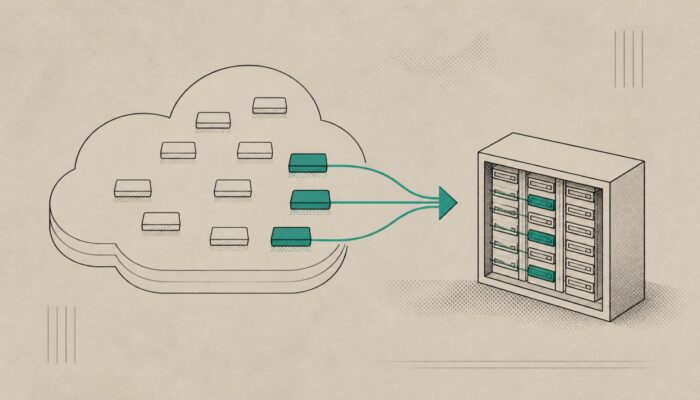
Eight out of ten companies want to bring at least one workload back from the cloud. Those who read this as a mass cloud exodus are falling for a statistical illusion – because only workloads that make financial sense are coming back. Architects and IT leaders now need to decide which workload types truly benefit from repatriation and which should stay where they are.
Key Takeaways
- Selective, not blanket: IDC figures range from 71 to 86 percent depending on definition. Repatriation is a targeted decision, not a strategic U-turn.
- Three drivers, not one: Persistent GPU inference loads, compliance pressure and data gravity determine what returns. Lumping all three together blurs the picture.
- Worth it: Steady-state AI inference, regulatory-critical databases, data-intensive pipelines. Not worth it: fluctuating web front-ends, small services without regulatory requirements.
- Hidden costs: Observability, licensing lock-ins from managed services and the skills gap between cloud-native and on-prem Ops are often left out of the calculation.
Related:FinOps: Realistically cut cloud costs by 30 percent / AWS and Azure under EU oversight: Lock-in starts to wobble
Why 86 percent doesn’t mean what it sounds like
The headlines are clear-cut: 86 percent of CIOs plan to bring workloads back from the public cloud. That sounds like an exodus. Dig into the studies, however, and you quickly see the figure is a range, not a hard fact. Depending on what counts as “repatriation” – full workload relocation, targeted tweaks or merely a hybrid realignment – the value swings between 71 and 86 percent.
An article in our sister publication Digital Chiefs calls these headlines a statistical illusion. The core message: instead of a blanket move back to on-prem hardware, companies are making selective decisions for specific workload types. Most firms stay hybrid – they deliberately shift what runs more cheaply or securely in their own data centres, while keeping what belongs in the cloud where it belongs.
For mid-market architects and IT leaders, the question is therefore: which workload goes where? To answer that, you need to separate workloads by driver rather than by sentiment.
Separate the three drivers – and where each one applies
The repatriation debate often conflates three entirely different motives. Without mentally untangling them, you risk infrastructure decisions that miss the mark.
Driver one: GPU and AI inference. The FinOps Foundation estimates that 80 to 90 percent of AI cloud spending goes toward inference rather than training. Live operations, they add, typically utilise GPUs at only 15 to 30 percent capacity. If you’re inferring 24/7, you’re paying cloud premium for idle muscle. That’s when an on-prem GPU cluster becomes economically attractive.
Driver two: compliance and data sovereignty. According to the Bitkom Cloud Report, 64 percent of cloud users feel compelled to rethink strategy because of US government policy, while 85 percent see Germany as too dependent on the US. Gartner calls this “geopatriation” – shifting workloads to sovereign or local environments. The driver here is political-regulatory, not purely economic.
Driver three: data gravity and latency. When massive data volumes exert a physical pull, cloud egress costs can exceed on-site operations. Pipelines moving terabytes gravitate back to where the data resides.
Which Workloads Are Worth Bringing Back – and Which Aren’t
These three drivers make it possible to draw up a clear matrix. The rule of thumb: anything that runs continuously, is regulatorily critical, or swings between high data intensity is a candidate for repatriation. Anything that fluctuates, remains small, and stays free of regulation is better left in the cloud.
Typically worth bringing back: Constantly running AI inference (GPU utilization in your own rack becomes economically viable at around 60 percent relevant sustained load), compliance-critical databases with DACH processing requirements, and data-intensive pipeline steps where cloud egress costs exceed on-prem operating expenses.
Usually not worth it: Fluctuating web frontends that benefit from the cloud’s scaling advantages. Small services without regulatory obligations where migration costs eat up runtime savings. Highly cloud-native services tied to proprietary managed offerings like AWS Lambda or Kinesis-here, re-engineering erodes the supposed savings.
What Technically Gets Left Behind When You Repatriate
The decision is only half the battle. What architects underestimate are the technical costs that often vanish from the business case.
Cloud-native services such as Lambda, Kinesis, or BigQuery are architectural choices, not interchangeable products. Bringing them back means rebuilding them with open-source equivalents like OpenWhisk, Kafka, or Trino-consuming engineering time. The new system is rarely a 1:1 functional match. Licensing lock-ins from managed services are the most common reason invoices spike once the initial euphoria fades.
Add observability gaps, network and storage latency, and the skills chasm between cloud-native and on-prem operations. A team that has spent three years running infrastructure-as-code in the cloud may not automatically know how to translate Terraform modules to bare metal. That’s not an argument against repatriation-it’s a line item that must appear in the cost-benefit analysis.
How Architects Can Decide Now-Without Fashionable Bias
A clean decision framework runs on three questions per workload: How constant is the load? How locally data-bound is it? How intense is the compliance pressure? If all three score “high,” you have a repatriation candidate. With two “no” answers, the cloud remains the right answer.
The math example: an on-prem GPU reserved instance becomes cheaper than cloud on-demand for 24/7 inference once utilization hits roughly 60 percent over a total-cost-of-ownership horizon of 18 to 36 months. Below that, the cloud’s elasticity still absorbs spikes without over-provisioning. The call is therefore mathematical rather than ideological-and that’s what makes it actionable.
Anyone repatriating a workload today should treat it as a pilot, not a template for everything. A successful repatriation of an inference pipeline proves viability, but it doesn’t automatically scale to the web frontend. Selectivity is discipline, not hesitation.
Frequently Asked Questions
When does on-prem GPU inference actually pay off?
The key levers are sustained utilisation above 60 percent, 24/7 workloads, and a total-cost-of-ownership horizon of 18 to 36 months. Below those thresholds, the cloud remains elastic enough to absorb spikes without expensive over-provisioning.
What happens to cloud-native services like Lambda or Kinesis when workloads are repatriated?
These services are architectural decisions, not interchangeable commodities. They must be rebuilt with open-source equivalents such as OpenWhisk or Kafka. That consumes engineering time and rarely delivers 1:1 feature parity-a common reason the business case collapses.
Does geopatriation solve my GDPR problem?
Only partially. Geopatriation relocates storage, but GDPR governs processing and the entire data-processor chain. Moving data geographically without adapting processing workflows merely shifts the retention question rather than resolving compliance obligations.
Isn’t 86 percent repatriation proof the cloud is failing?
No, because the figure represents a range from 71 to 86 percent and fluctuates with definition. The real message is a selective, hybrid realignment-not a wholesale cloud exit. Eighty-six percent plan to repatriate at least one workload, not every workload.
What belongs in the business case for repatriation?
Beyond hardware and run-time costs: engineering effort to re-implement managed-service-bound features, egress charges for the initial transfer, observability tooling migration, and upskilling the team. Missing these items later generates re-return costs that can erase the projected savings.
Editor's Picks
cloudmagazinFinOps: Realistically cutting cloud costs by 30 percentcloudmagazinAWS and Azure under EU oversight: the lock-in wobblescloudmagazinAWS removes the agent layer-yet the catch remainsMore from the MBF Media Network
Translated from the German original using artificial intelligence. The German version is authoritative.


