

Grid Connection Becomes the Bottleneck for AI Data Centers
The VDE warns: grid connection is becoming the bottleneck for AI data centers. Load profiles, voltage, and storage need the same rigor as compute capacity.
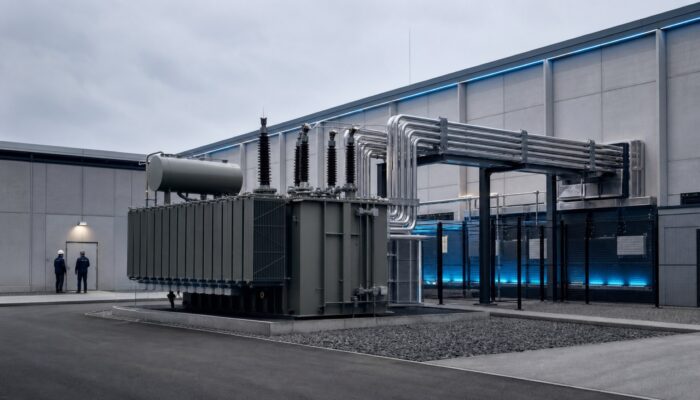
Connecting high-performance AI data centers to the power grid is becoming increasingly problematic. The VDE states this unmistakably in a joint short brief from ITG and ETG dated 16 July 2026. Operators and planners must plan load profiles, voltage levels, and on-site storage as rigorously as the compute capacity itself.
Key takeaways
- Load profiles diverge. Training and inference pull differently on the grid. Anyone who plans only annual energy underestimates transient peaks and the connection at the substation.
- Four levers in the building. Control load peaks, raise the voltage level, layer storage, and treat cooling as part of power density. 48-volt distribution is hitting its limits.
- Standardization is still missing. Different voltage levels are common in AI data centers. The VDE sees standardization as the key to compensation and the market.
Related:When the Data Center Breathes with the Power Grid / 800 Volts in the Data Center: NVIDIA’s Push for AI
Training and inference pull differently on the grid
Classic data centers often run with a relatively steady baseload. Servers run, cooling load follows the daily pattern, and the connection is sized to a plannable average plus reserve. AI load breaks this pattern. Training and inference form two distinct load families with clearly different power and energy profiles.
Training drives racks close to rated power over long phases. Collective communication steps and checkpoint cycles create short, steep peaks above that. Inference responds more strongly to request volume. It can run more quietly for hours and then ramp up within minutes when a product launch or a batch job fills the queue. For the grid connection, what matters is less the annual kilowatt-hour than the power draw in seconds and minutes.
Damian Dudek, Managing Director of VDE ITG, draws attention to exactly this: the differences demand an analysis of energy and power demand in transient consumption. Only then can mechanisms take hold that balance load peaks. Anyone who only reads the average from the energy report is planning past the switchgear. The report must not smooth out the peak curve.
Compute capacity is orderable, connection capacity is not
The VDE sums up the situation more succinctly than many market reports: connecting high-performance AI data centers to the power grid is becoming increasingly problematic. Grid expansion is expensive, and the demands on stability and resilience grow with every large hall. Compute capacity is orderable. Connection capacity at the site often is not. Between contract signature and released capacity lie planning rounds that no GPU roadmap shortens.
Prof. Dr. Andreas Ulbig of RWTH Aachen and board member of VDE ETG classifies the grid connection as a substantial challenge. Regulatory frameworks and the availability of energy and connection capacity collide hard, especially in metropolitan areas. For operators, that means: the critical decision often falls years before the first rack, in the load forecast submitted to the grid operator.
German data centers consumed around 21.3 billion kilowatt-hours in 2025, according to Bitkom and Borderstep. Connection capacity used for AI is expected to rise from 530 megawatts to 2,020 megawatts by 2030, against a total capacity most recently of 2,980 megawatts. These figures explain why connection questions are moving from the background into the foreground. More load meets grids that do not grow in step with GPU supply chains.
I have stood in halls where the nameplate on the distribution looked clean and the measurement curve still showed spikes that no monthly average reveals. Peaks are not Excel noise. They decide whether the grid operator releases the next construction phase or sends the plan back.
48 volts hits its limits, 800 volts cuts losses
Power distribution in the building is the second bottleneck after the grid connection. Prof. Dr.-Ing. Gerd Griepentrog of TU Darmstadt makes it clear: conventional 48-volt distribution systems hit their limits at the high power levels of modern AI racks. More current at low voltage means thicker copper cross-sections, higher losses, and less room in the shaft.
Switching to an 800-volt direct current distribution system significantly reduces current losses and copper demand, according to the VDE short brief. DC/DC converters step down from 800 volts to 48 volts and keep existing 48-volt components at the rack connection-ready. According to Griepentrog, these converters currently reach efficiencies of up to 98 percent and deliver a precise output voltage. Research aims to reduce conversion stages further.
The voltage level is one lever among several. The decisive question for operators is: which voltage level do I carry from the building feed to the rack edge, and how early do I lock that in? Late redesign costs space, copper, and time. Early architecture decisions relieve the connection and the operating balance sheet. Anyone who only thinks about distribution after ordering the IT pays twice: in material and in delay.
Layer storage and factor in power density
ITG and ETG propose multi-layer storage architectures to absorb load fluctuations on different timescales. Battery storage and uninterruptible power supply (UPS) interlock: short peaks here, longer balancing windows there. Many operators are already implementing this. The concrete design depends, according to Dudek, on site, training or inference requirements, and the grid operator’s specifications.
Controlling load peaks means in practice: measure the power that the grid connection contract allows. Smooth it internally so the peak does not breach the contract. Storage buys time. It does not replace grid expansion, but it makes connections usable that would otherwise block under unconstrained transient load. Anyone who does not model peaks either buys too much connection reserve or risks curtailment in operation.
Power density per rack drives both. More kilowatts on the same floor space load distribution and cooling at the same time. Cooling is not a separate product chapter here. It is part of the power balance: every watt of waste heat must be removed and increases the building’s ancillary load. Anyone who plans only the IT kilowatts and adds cooling later systematically underestimates connection demand. In practice, IT and facility sit on the same application.
The standardization gap remains, decisions do not wait
Different voltage levels have so far been common in AI data centers. The VDE sees standardization as the key. Dudek names the benefits: size compensation equipment better, open the market for suitable technology, and accelerate the integration of renewable energy. As long as every campus runs its own voltage and storage combinations, every plan remains more expensive and harder to compare.
Operators can still act. First, analyze energy and power demand separately, including transient peaks from training and inference. Second, set the voltage level of building distribution early and coordinate it with the grid operator. Third, size the storage architecture beyond the emergency-power case, as a connection and operating instrument. Fourth, carry cooling along in power density so the connection application reflects real building load.
The short brief sells nothing. That is exactly why it is useful for decision-makers: it describes the bottleneck from an engineering perspective and names levers inside the operator’s own building. Models and benchmarks remain important. Without power in front of them, they remain slides. The operational mandate is to plan the power path and the workload together.
- Load profiles of training and inference differ and require power and energy analysis
- 800-volt direct current reduces losses and copper demand; DC/DC converters reach up to 98 percent efficiency
- Multi-layer storage from battery and UPS is in field use and relieves load peaks
- Which voltage level will prevail as the standard is not yet decided
- Storage design remains site- and grid-dependent; there is no universal recipe
- How fast connection capacity grows in metropolitan areas is steered by the local grid operator
Frequently Asked Questions
Why is the grid connection of AI data centers a problem?
High-performance AI data centers need high connection capacity and generate load peaks that classic average-based planning underestimates. Grid expansion and available capacity grow more slowly than demand for compute. Especially in metropolitan areas, regulatory requirements and scarce connection quotas collide. The bottleneck often sits at the substation and in building distribution before the first chip runs.
How do training and inference differ in power demand?
Training often keeps racks close to rated power for long periods and generates steep peaks during collective compute and storage operations. Inference follows request volume more closely and can rise suddenly when usage or batch jobs increase. Both profiles require separate consideration of energy demand and instantaneous power. Balancing mechanisms only take effect once transient loads are known.
Why do 48-volt systems hit limits in power distribution?
At high power density per rack, currents rise sharply at low voltage. That drives copper demand, losses, and thermal stress in cables and busbars. 800-volt direct current reduces these effects because less current flows at the same power. Converters step back down to 48 volts at the rack and keep existing components connection-ready.
What does the VDE mean by multi-layer storage architecture?
It means the combination of battery storage and uninterruptible power supply that cushions load fluctuations on different timescales. Short peaks and longer balancing windows are served separately. The exact layout depends on site, workload, and grid requirements. The goal is flexible load peak management that goes beyond classic emergency power supply.
What can operators decide before standards take effect?
They can measure and model power and energy profiles for training and inference. They can place voltage level and storage early in building design and carry cooling along in power density. Realistic peak loads rather than only annual averages should be communicated with the grid operator. Standardization is still missing, but architecture decisions in the operator’s own house do not wait for the standard.
Editor’s Picks
cloudmagazinEnEfG Amendment Eases PUE Limits for Data CenterscloudmagazinSovereign Cloud Fails at the Connection, Not at the CodecloudmagazinAI Campuses in DE: Live, Separate Construction and PlanningMore from the MBF Media Network
MyBusinessFutureConstruction Prices +5 Percent: Recalculate CapexDigital ChiefsDespite PUE Relaxation: Data Centers at 21.3 Billion kWh in 2025SecurityTodayGlass Chips: Lower Cooling Demand in the Data CenterImage source: AI-generated (July 2026)


