

Sustainable IT in Logistics: How the Cloud Greens the Last Mile
The last mile accounts for up to 50 percent of CO2 emissions in a supply chain. Cloud-based route optimization, emission dashboards, and electric fleets show how IT drives change.
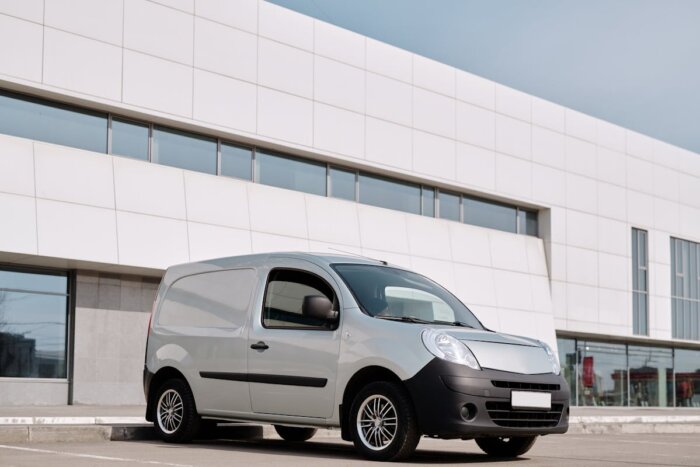
Freight logistics accounts for 7 to 8 percent of global greenhouse gas emissions. The last mile alone accounts for up to 50 percent of a supply chain’s CO2 footprint. At the same time, a WEF report shows: AI-powered operations could reduce logistics emissions by 15 percent (WEF, Intelligent Transport Report, 2025). Only 3.72 percent of EU companies are currently using this technology.
The key points at a glance
- 7-8 percent of global emissions: Freight logistics is one of the largest CO2 emitters worldwide (WEF, 2025).
- Last mile = biggest lever: 30 to 50 percent of supply chain emissions are generated on the last kilometers to the customer.
- UPS saves 100,000 tons of CO2 annually: The ORION system optimizes over 200,000 route options per driver every day (INFORMS).
- DHL: 39,000 electric vehicles in use: 41 percent of the delivery fleet is already electric, with a target of 66 percent by 2030.
- CSRD obligation affects 50,000 EU companies: Scope-3 reporting makes logistics emissions in the supply chain visible and reportable for the first time (CSRD overview on Digital Chiefs).
Why the last mile is the biggest problem
The figures are clear: 204 grams of CO2 per parcel on global average (Statista, 2022). In the Netherlands, this value was halved to 100 grams through systematic optimization (Supply Chain Movement, 2024). Without countermeasures, UPIDO predicts that e-commerce deliveries will grow to 5.5 million tons of CO2 annually by 2032.
Urban logistics exacerbates the problem: In the world’s top 100 cities, logistics emissions are set to rise by 30 percent by 2030 unless countermeasures are taken, according to the WEF. The reason lies in fragmentation. More and more parcels to more and more addresses with ever shorter delivery promises. Same-day and next-day delivery force logistics services into inefficient individual trips. Autonomous warehouses mitigate the problem at the interface between warehouse and last mile.
Source: WEF, Intelligent Transport Greener Future, 2025
Cloud-Based Route Optimization: The UPS Proof
UPS’s ORION system is the best-documented example of what cloud-based route optimization can achieve. The system analyzes over 200,000 possible route variations per driver each day and selects the most efficient one. The result: 10 million fewer gallons of fuel per year and 100,000 tons of CO2 saved (INFORMS Case Study).
The dynamic ORION upgrade reduces daily driving distance by an additional 2 to 4 miles per driver. Applied across the entire UPS fleet, this translates to 100 million fewer miles driven and $300 million in annual cost savings (Supply Chain Dive).
For IT decision-makers, the takeaway is clear: The platform runs in the cloud, scales across tens of thousands of drivers, and pays for itself not over years, but within months. Route optimization is no longer an innovation project. It’s foundational infrastructure-comparable to energy-efficient cooling in data centers.
Emissions dashboards: Scope-3 becomes measurable
The CSRD makes Scope-3 emissions reportable for around 50,000 EU companies. For most companies, supply chain emissions account for up to 80 percent of the total CO2 footprint (BCG, 2025). The problem: Many companies do not even know their Scope-3 data.
Maersk has created a cloud platform with the Emissions Dashboard where customers can consolidate their CO2 data across all carriers and transport modes. The system also records non-Maersk transports. The ECO Delivery Ocean program reduces emissions by up to 85 percent compared to fossil fuels, verified by PwC according to ISAE 3410. Companies such as Nestlé, Novo Nordisk, and Grundfos switched all their Maersk ocean transports to ECO Delivery in 2024.
Electric fleets: Amazon and DHL scale up
At the end of 2025, Amazon operates over 30,000 Rivian electric delivery vans in the USA, a 50 percent increase compared to the previous year. In 2024, the vehicles delivered over one billion packages. Amazon operates over 17,000 of its own charging points, making it the largest private charging infrastructure in the world (Electrek, 2026).
DHL currently uses over 39,000 electric vehicles in delivery services. This corresponds to 41 percent of the fleet. By 2030, the share is set to rise to 66 percent. In Germany alone, 2,400 Ford Pro E-Vans will be added. The GoGreen Plus program achieved a reduction of 1,598 kilotons of CO2e in 2024, verified by an independent audit. Over 300,000 customers worldwide use the service (DHL Group, 2025).
EU regulation as an accelerator
The EU is increasing pressure on several levels at the same time. The new CO2 standards for heavy-duty vehicles require a reduction of 45 percent by 2030 compared to 2019, and 90 percent by 2040 (EU Council, May 2024). City buses must be completely emission-free by 2035.
The Alternative Fuels Infrastructure Regulation (AFIR) requires charging points with at least 350 kW every 60 kilometers on the TEN-T core network from 2025. FuelEU Maritime has been demanding a gradual reduction in greenhouse gas intensity in shipping by up to 80 percent by 2050 since January 2025.
For IT departments, this means: Compliance-capable data infrastructure is becoming mandatory. Those who cannot measure Scope-3 emissions will not be able to report them. Cloud platforms for emissions tracking are no longer optional but a basic requirement – and securing the software supply chain is part of this.
Conclusion
The technology is here: AI route optimization, cloud emissions dashboards, electric fleets. What is missing is scaling. 96 percent of EU companies are not yet using AI in logistics. UPS shows what is possible: 100,000 tons less CO2 per year through a single cloud system. The CSRD makes Scope-3 reporting mandatory and thus also the IT infrastructure that enables it.
Frequently asked questions
What is Scope-3 and why does it affect logistics?
Scope-3 includes all indirect emissions in a company’s value chain, including transport, storage, and delivery. For many companies, these emissions account for up to 80 percent of the total CO2 footprint. The CSRD makes reporting mandatory for around 50,000 EU companies.
How much CO2 does a single parcel cause?
On global average, around 204 grams of CO2 per parcel. In optimized markets like the Netherlands, the value is around 100 grams. The variance is large and depends on distance, vehicle type, and delivery density.
Is an electric fleet worthwhile for medium-sized logistics companies?
The total cost of ownership is continuously decreasing. E-vans have lower operating costs (electricity vs. diesel, less maintenance). DHL and Amazon show that scaling works. For smaller fleets, leasing models and funding programs offer an entry point.
How much can cloud-based route optimization save in concrete terms?
UPS saves 10 million gallons of fuel and 100,000 tons of CO2 per year with ORION. Studies generally show a reduction potential of up to 20 percent in emissions through professional route optimization.
Which cloud platforms are suitable for emissions tracking?
Maersk offers a platform for multimodal tracking with the Emissions Dashboard. Specialized providers like Planetly, Persefoni, or Watershed cover broader ESG requirements. The key is the ability to aggregate Scope-3 data across different carriers and transport modes.
Editor's Picks
cloudmagazinAutonomous warehouses 2026: Robotics and AI in intralogisticscloudmagazinHigh Performance, Low Carbon: Future-proof coolingMore from the MBF Media Network
Digital ChiefsSustainability as a competitive advantage: CSRD on the executive agendaDigital ChiefsGreen IT: Sustainability as a value driverImage source: Pexels / Norma Mortenson (px:4391469)
Translated from the German original using artificial intelligence. The German version is authoritative.


