

Cloud-ECM: a first step toward digitalization for SMEs
How Cloud-ECM helps SMEs get started with digitalization, using solutions from TA Triumph-Adler.

Enterprise Content Management (ECM) systems are becoming increasingly established in German companies. A recent market analysis by Fortune Business Insights confirms the growing acceptance across Europe, and ECM usage shows remarkable growth: in 2025, Europe contributed 12.17 billion US dollars to the global market, equivalent to a share of almost 25 percent. In 2026, the figure is expected to reach 14 billion US dollars. This growth is driven by the increasing acceptance of cloud-based services. Small and medium-sized enterprises (SMEs) in particular recognize the benefits of cloud-based ECM systems: digital workflows can be introduced in a standardized, step-by-step way and make it easier to capture, process and manage business documents and information. Olaf Stammer, Manager Solution Marketing at TA Triumph-Adler, explains how to introduce a cloud ECM effectively.
Key takeaways
- The ECM market in Europe is growing. In 2025 it stood at 12.17 billion US dollars, almost 25 percent of the global market. In 2026, the figure is expected to reach 14 billion.
- Improving IT security is a goal of cloud adoption. According to the Bitkom Cloud Report 2026, 75 percent of companies aim to improve IT security by using cloud solutions.
- Cloud ECM starts as SaaS. A workshop clarifies the requirements; administrators and key users deliver the training.
ECM systems give companies a central platform for capturing, managing, archiving and processing digital documents. Common records such as invoices, business letters or contracts that a company receives via email, uploads or scans can be captured automatically in an ECM, versioned and routed into defined approval, review or processing workflows. For this purpose, the systems offer standardized modules, such as digital accounting, digital personnel files, digital contract management or digital project files, which can also be introduced step by step. Digitalizing these essential business processes makes collaboration within an organization easier and more efficient. In addition, cloud-based ECM solutions can support hybrid ways of working and strengthen companies’ IT security.
Secure digital document processes for companies of every size
According to the Cloud Report 2026 by the digital association Bitkom, 75 percent of companies pursue the goal of increasing their IT security by using cloud solutions. This trend is also evident in the ECM market. The advantage of a cloud-based ECM over an on-premises solution is that professional service providers deliver the solutions from data centers that implement strict security strategies. Companies benefit from certified security standards, robust protective mechanisms and highly available IT systems.
In addition, cloud-based ECM systems offer greater flexibility. They are offered as software-as-a-service (SaaS) models. Companies pay only for the service modules they need. Depending on current demand, resources such as storage capacity, IT services and additional services can be scaled quickly. If the workload is lower at times, the service can be flexibly adjusted. The modular structure of modern ECM systems from the cloud also allows a tailored setup, so new functions can easily be added.
Cloud ECM also offers clear advantages in the context of hybrid working. Employees who want to work from home or from any location need secure access to relevant documents and information at all times. A cloud-based ECM solution enables exactly that: important information, records or documents can be securely found, retrieved or updated from anywhere and at any time.
How to successfully implement a cloud-based ECM system
For companies convinced of the benefits of a cloud-based ECM system, the question arises of how best to introduce it. To keep daily operations from suffering, the approach should be strategic and a concept should be drawn up in advance. Especially at the beginning, it can pay off to involve experienced service providers. They can help develop a structured implementation plan. During the concept phase, it is important that a company first thinks carefully about what the ECM system will specifically be used for in the future, so that requirements can be defined as precisely as possible. A cross-departmental workshop is therefore a common way to begin the process.
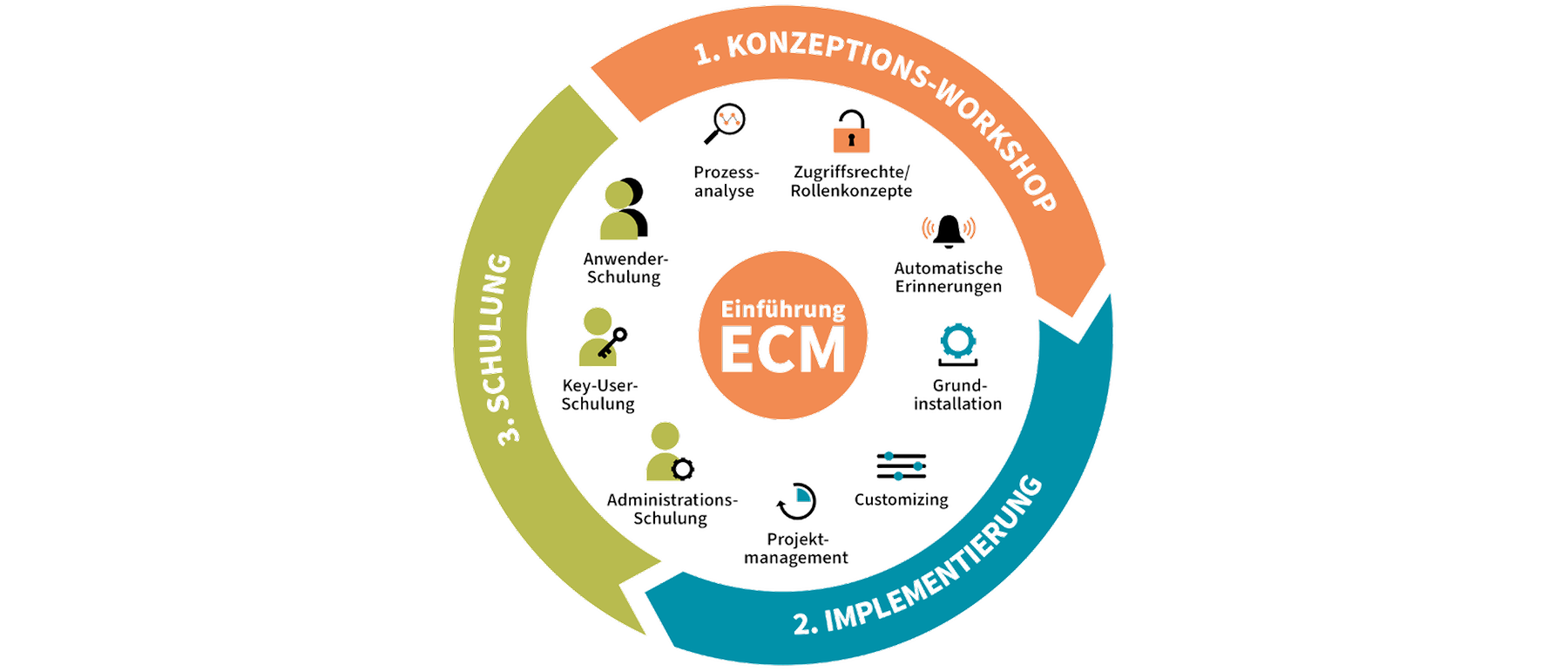
Ideally, workshops of this kind should shed light on the technical side while also including the perspective and the concrete needs of the employees. The technical side includes looking at existing processes in detail. This usually reveals starting points for leaner workflows. In parallel, the teams can provide valuable feedback on which existing processes work well and which work less well, and on what optimal workflows look like from the employees’ point of view. The more detailed and specific the analysis, the better the resulting workflows. Therefore, alongside IT specialists, the management should also take part in the workshop wherever possible. This way, everyone is on board from the start, and fundamental issues such as costs, timing or access rights can be agreed and defined directly.
Based on the workshop findings, the ECM provider can develop a tailored plan to guide implementation. If a company opts for a cloud-based ECM, complex configuration and deployment of the solution within the company’s own IT environment are no longer needed. Companies do not need their own servers for document management, and the Cloud-ECM solution can be provisioned within a very short time.
Once the ECM system has been implemented and the workflows are set up, the users are trained. These training sessions go into different levels of detail. The administrator training shows how the system works and how it is structured, because administrators are responsible for managing and maintaining the IT infrastructure. As part of the key user training, team leaders become familiar with the ECM solution. These sessions are also quite comprehensive, because in practice it has proven useful for key users to train the end users in the next step. Finally, end-user training prepares employees to work with the ECM system every day.
How many employees need to be trained, and how intensively, depends on the size of the respective company: at SMEs, all employees who deal with the ECM system should be trained. At companies with 500 or more employees, practice has shown that, apart from the administrators, it initially makes sense to train only the key users, who then pass on their knowledge.
Cloud ECM as an efficient entry point into digitalization
The growing trend toward cloud-based ECM among SMEs is no coincidence: fundamental business processes can be digitalized efficiently. Since the benefits outlined above can quickly become noticeable in daily operations for the management and for the employees, a kind of digital domino effect often emerges with regard to introducing new digital processes. What is decisive is that digitalization is implemented strategically. Working with an experienced partner, companies can plan and implement digitalization effectively while conserving resources. In addition, cloud-based software-as-a-service solutions make it possible to outsource the operation of ECM systems: full-service offerings can supplement digital document management, for example, with integrated IT security functions, automatic updates and configurable storage capacities and locations. In this way, companies of every size can benefit from the advantages of digitalization and specifically strengthen their competitiveness.

Olaf Stammer is Manager Solution Marketing at TA Triumph-Adler. As a managed service provider, TA supports companies in optimizing paper-based and digital document processes, with the goal of making them more effective. The product portfolio comprises hardware, software and IT service solutions that cover the entire document processing workflow. As an expert in document management solutions, Olaf Stammer has held various positions at TA since 2003, driving the development and sale of modern IT solutions and services and advising companies on their use to support effective business processes. View the LinkedIn profile.
Detailed information on this topic can be found at: Enterprise Content Management by TA Triumph-Adler.
Frequently Asked Questions
What does an ECM system do?
It is a central platform for capturing, managing, archiving and processing digital documents. Invoices, business letters or contracts received by email, upload or scan are captured automatically, versioned and routed into approval, review or processing workflows.
What advantages does a cloud ECM have over an on-premises solution?
Professional service providers run it in data centers with strict security strategies. With the software-as-a-service model, companies pay only for the modules they need, and storage and services can be scaled quickly. Dedicated servers for document management are no longer required.
How does the introduction of a cloud ECM start?
With a cross-departmental workshop that analyzes existing processes and takes employees’ needs into account. Alongside IT specialists, management should take part if possible. Costs, timelines and access rights can then be agreed directly.
Who needs to be trained in the company?
In small and medium-sized companies, every employee who works with the ECM system. In companies with 500 or more employees, administrators and key users are trained first and then pass on their knowledge.
Editor's Picks
cloudmagazinWhen the document becomes the bottleneck: why automation failscloudmagazinDocument management: AI for efficient filing and processesMore from the MBF Media Network
MyBusinessFutureDocument AI: where bureaucracy costs really fallDigital ChiefsRecords Management as a CIO topic: why governance needs ownershipSecurityTodayThe AI Act is in fact a security lawImage source: AI-generated (September 2026)
Translated from the German original using artificial intelligence. The German version is authoritative.


