

Liquid Cooling in Data Centers – A Rapidly Growing Market
Data centers increasingly demand more powerful cooling systems. The most cost-effective approach is spraying or immersing components directly in coolant liquid – a massive growth market, as an Airsys study shows. TL;DR …
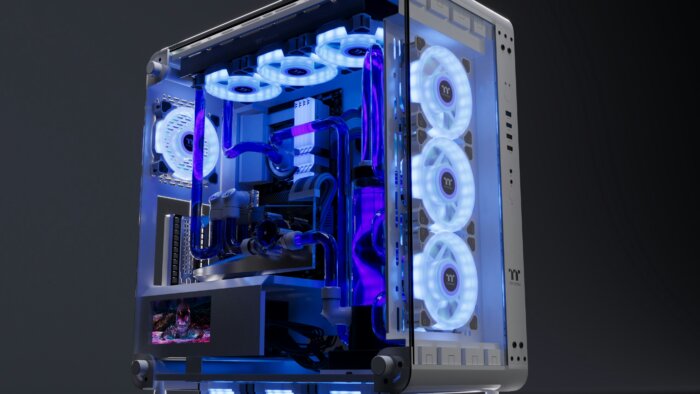
Data centers increasingly demand more powerful cooling systems. The most cost-effective approach is spraying or immersing components directly in coolant liquid – a massive growth market, as an Airsys study shows.
TL;DR
- The global liquid cooling market for data centers reached $3.2 billion in 2023.
- Europe’s market grew by 27.6% in 2023 to $1.07 billion; North America reached $1.16 billion.
- Strict data privacy regulations and sustainability goals are accelerating growth across Europe.
- Annual growth of approximately 19% is projected between 2024 and 2032.
- Airsys uses a spray-based method instead of immersion – reducing coolant consumption and lowering PUE values to below 1.03.
Global Market Insights estimates the global liquid cooling market for data centers stood at $3.2 billion in 2023. Between 2024 and 2032, it is expected to grow at an average annual rate of 19%. This projection comes according to IT-Business from Airsys’s latest Data Center Liquid Cooling Market Report, in collaboration with Market Insights.
Europe’s liquid cooling market rose by 27.6% in 2023 – to $1.07 billion – outpacing North America’s growth, even though North America remains larger at nearly $1.16 billion. Analysts attribute rising demand in “the Old World” partly to stringent data privacy rules. Another key driver is Europe’s stronger commitment to sustainability and green data center technologies.
Growth Drivers and Key Players

Efficient liquid cooling: Airsys opts for spray-based cooling rather than immersion. Source: Unsplash / Bhautik Patel
The historically high – and still projected – growth rates stem not only from new data center construction but also from expansions of existing facilities operating at higher processor and memory module densities. Cloud computing and artificial intelligence further fuel global demand for both data centers and liquid cooling solutions.
As noted by Market Insights and IT-Business, alongside established data center infrastructure vendors – Vertiv, Rittal, and Schneider Electric (headquartered in Garching near Munich) – a “diverse mix” of companies is entering the space. These include 3M, Alfa Laval AB, Coolit Systems, IBM, and Mitsubishi Electric.
Also joining the field is Petronas Lubricants International. The Malaysian lubricant specialist – subsidiary of Petronas – announced in June 2024, together with Iceotype, the launch of a new data center coolant designed to boost efficiency while reducing emissions and water consumption.
Spraying Instead of Immersion Cuts Cooling Infrastructure Needs
Liquid cooling falls into two main categories: immersion cooling – submerging components in coolant – and direct-to-chip cooling, such as Airsys’s spray-based approach, where coolant is sprayed directly onto components. The latter significantly reduces the required cooling infrastructure. Airsys’s “Liquid Rack” solution, per manufacturer specifications, uses only about 10% of the coolant volume required by immersion systems. As a result, PUE values can drop below 1.03. Airsys specifies the rack’s cooling capacity at 20-150 kilowatts.
A non-conductive liquid coolant is sprayed onto servers to absorb heat. The warmed coolant then flows into a reservoir, from which a dual-pump system transfers it to a plate heat exchanger. There, heat is dissipated either via a dry cooler into the atmosphere – or repurposed as district heating. Within the Liquid Rack, a precision spray nozzle delivers the non-conductive fluid point-by-point directly onto server processors, preventing thermal hotspots. This approach significantly extends server lifespans and reduces maintenance requirements.
Frequently Asked Questions
What was the global liquid cooling market volume for data centers in 2023?
The global market reached $3.2 billion in 2023. In Europe, it totaled $1.07 billion.
Why is Europe’s liquid cooling market growing faster than North America’s?
Analysts cite strict data privacy regulations and Europe’s stronger commitment to sustainability and green data center technologies.
Which cooling technology does Airsys use?
Airsys employs direct-to-chip cooling using a spray-based method – not immersion cooling. Components receive precisely targeted sprays of non-conductive liquid.
What advantages does Airsys’s spray method offer over immersion?
The spray method consumes only about 10% of the coolant volume used in immersion systems. It lowers PUE to under 1.03 and cuts maintenance needs.
Which companies – beyond traditional infrastructure vendors – are active in the liquid cooling market?
In addition to Vertiv, Rittal, and Schneider Electric, players include 3M, Alfa Laval AB, Coolit Systems, IBM, Mitsubishi Electric, and Petronas Lubricants International.
More from the MBF Media Network
SecurityToday | MyBusinessFuture | Digital Chiefs
Header Image Source: Unsplash / Bhautik Patel
Translated from the German original using artificial intelligence. The German version is authoritative.


