

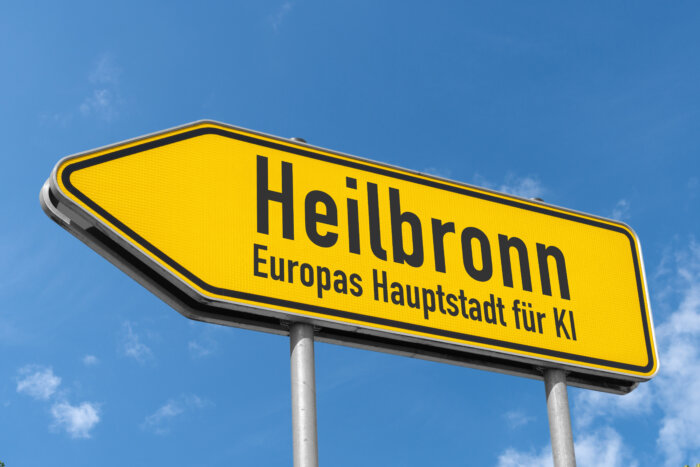
Heilbronn Aims to Become Europe’s AI Capital
TL;DR: North of Neckarsulm, the Schwarz Group began constructing a project campus back in 2020. The AI Innovation Park IPAI in Heilbronn is set to become Europe’s largest AI hub – spanning …
TL;DR: North of Neckarsulm, the Schwarz Group began constructing a project campus back in 2020. The AI Innovation Park IPAI in Heilbronn is set to become Europe’s largest AI hub – spanning 30 hectares…
With the Schwarz Group as lead investor and additional funding from the state of Baden-Württemberg, Heilbronn will host Europe’s largest AI Innovation Park, IPAI. Federal Chancellor Friedrich Merz attended the groundbreaking ceremony on 21 October.
Surprisingly, Europe’s largest AI hub is taking shape in the tranquil city of Heilbronn – funded by money flowing in from the equally unassuming town of Neckarsulm. There, the Schwarz Group – Europe’s largest retail conglomerate, operating Lidl and Kaufland – has its headquarters. Together with its subsidiary Schwarz IT KG, it ranks among Germany’s major IT and telecommunications players. Its portfolio includes STACKIT, the cloud platform jointly developed with SAP, as well as strategic investments in AI and quantum computing – including stakes in Aleph Alpha and IQM – and the secure instant messaging service Wire.
North of Neckarsulm, the Schwarz Group broke ground on a project campus back in 2020. Now, the AI Innovation Park IPAI in Heilbronn aims to shatter all expectations: spanning 30 hectares, it promises to deliver 5,000 new jobs to a city of just under 132,000 residents.
Merz Lifts the Spade; Baden-Württemberg Provides Funding
It’s no surprise that, according to Tagesschau, the groundbreaking ceremony for the AI center on 21 October 2025 drew not only Baden-Württemberg’s Minister-President but also Federal Research Minister Dorothee Bär and Federal Chancellor Friedrich Merz. Altogether, the Schwarz Group – as lead investor – and the state of Baden-Württemberg will invest around €3 billion in building the AI campus.

Groundbreaking ceremony in Heilbronn: With Federal Chancellor Merz, construction begins on Europe’s largest AI Innovation Park – a milestone for tech’s future. (Source: Adobe Stock / JUN LI)
During his brief visit, Chancellor Merz praised the initiative as “a fantastic bet on our country’s potential” – even though financial backing ultimately comes from the state of Baden-Württemberg, not the federal government.
Nonetheless, Merz underscored the urgency: “We face the challenge of rapidly achieving technological sovereignty – in Germany and across Europe.” What matters now, he added – quoting ARD – is translating existing research capacity into innovation power and economic value. Additional funding is expected from the Dieter Schwarz Foundation.
More than 80 partners are on board, including industry heavyweights such as SAP, Deutsche Telekom, Porsche, agricultural machinery manufacturer Claas, Stihl, Würth, Vodafone, and automotive and aerospace supplier Recaro.
Entering the Global Race Takes Courage
According to Tagesschau, regional companies have also joined the mammoth project – including IT services provider Bechtle, fan manufacturer Ziehl-Abegg, and mechanical engineering firm Schunk. Even football club VfB Stuttgart is involved. Moritz Gräter, Managing Director of IPAI, described the effort as an act of courage: “the courage to actively shape the future.” But, Tagesschau reports, it also takes courage to take on the seemingly impossible race against AI giants from the US and China.
When it comes to large language models (LLMs), Germany and Europe lag “miles behind” industry leaders like OpenAI – the developer of ChatGPT. “We simply can’t compete with the big language models,” said Wolfgang Eppler, AI researcher at the Karlsruhe Institute of Technology (KIT). Europe lacks both the financial resources and the infrastructure needed for an AI arms race with China and the US. Compounding the challenge is the immense energy demand required to train LLMs.
“In Germany, unlike elsewhere, it’s neither conceivable nor desirable for a corporation to suddenly buy a nuclear power plant – or restart an old one,” Eppler added, pointing to the massive energy requirements. Moreover, companies need extremely high upfront investment before they can even begin generating profit from their own language models.
Europe’s Strength Lies in Its Niche
Merz spoke of courage – but has even bigger plans. His next goal is to bring a massive AI data center to Germany as part of the broader European AI initiative. Katharina Hölzle, who heads the Institute for Industrial Engineering and Technology Management (IAT) in Stuttgart, highlights another critical bottleneck: despite ranking third globally in AI research – behind only the US and China – Germany suffers from a severe lack of knowledge transfer. Decades of foundational AI research have failed to generate enough startups or successfully translate into commercial applications.
On this point, however, Hölzle sees IPAI in Heilbronn as a genuine game-changer: “I believe a visionary project like this – one that maps the entire value chain from early education through to innovation, brings together all stakeholders, builds international and national influence, and is backed by sufficient funding, political will, and risk-taking courage – is the only viable path toward developing AI solutions ‘Made in Europe.’”
Header Image Source: Adobe Stock / hkama
Translated from the German original using artificial intelligence. The German version is authoritative.
Frequently Asked Questions
What’s key about “Merz lifts the spade; Baden-Württemberg provides funding”?
It’s no surprise that, according to Tagesschau, the groundbreaking ceremony for the AI center on 21 October 2025 drew not only Baden-Württemberg’s Minister-President but also Federal Research Minister Dorothee Bär and Federal Chancellor Friedrich Merz. Altogether, the Schwarz Group – as lead investor – and the state of Baden-Württemberg will invest around €3 billion in building the AI campus.
What’s key about “Entering the global race takes courage”?
According to Tagesschau, further regional companies have joined the mammoth project – including IT services provider Bechtle, fan manufacturer Ziehl-Abegg, and mechanical engineering firm Schunk. Even football club VfB Stuttgart is on board. Moritz Gräter, Managing Director of IPAI, spoke of courage…
What’s key about “Europe’s strength lies in its niche”?
Merz also spoke of courage – but is planning something even larger: the next step is a massive AI data center, which he intends to bring to Germany as part of the European AI initiative. Katharina Hölzle, who leads the Institute for Industrial Engineering and Technology Management (IAT) in Stuttgart…


