

Ghost Core brings the AI agent into the living room
Ghost Core runs local AI agents around the clock. Its first batch is sold out according to its founder; RTX Spark PCs are expected in autumn.
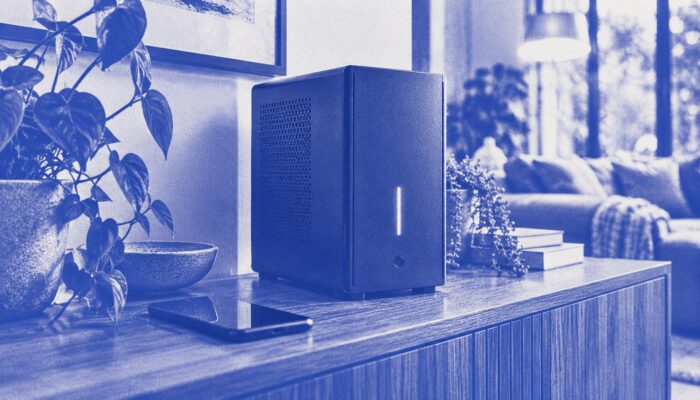
Start-up Ghost sells Core, a computer that continuously runs open AI models and local AI agents with access to mail and calendars on the device. According to its founder, the first batch, priced at around 3,120 euros excluding tax, is sold out and due to ship in late October. PCs with NVIDIA RTX Spark are expected to follow in autumn.
Key takeaways
- Ghost Core continuously runs open AI models and a personal agent on the device. According to its founder, the first batch, priced at around 3,120 euros excluding tax, is sold out and due to ship in late October.
- The data promise applies to the AI model and its memory. Core still needs an internet connection for web searches, email and software updates.
- According to Gartner, small, task-specific models are expected to be used three times as often as large language models by 2027. Alongside Ghost, ASUS, Dell, HP, Lenovo, Microsoft Surface and MSI are expected to launch devices with NVIDIA RTX Spark in autumn.
Related:Downloadable Doesn’t Mean Deployable / DGX Spark vs. Mac Mini: Prefill counts
The personal AI computer
Zain Javaid is 19 years old, previously worked as a quantitative trader and has raised around 9.8 million euros in seed funding, an early financing round, for his start-up Ghost. Andreessen Horowitz leads the round, with Abstract, Audacious Ventures, SV Angel and Nova also participating. The product is called Core. Ghost describes it as a personal AI computer that runs local models entirely on the device around the clock.
Core is controlled through a laptop, mobile app or iMessage. The device connects to mail, calendars, files, smart-home devices and browser history, as well as wearables such as Oura, Eight Sleep and Whoop. Core has its own file system, a browser and tools for taking action itself. In the demonstration, the agent searches the web for removal companies in San Francisco, calls them and compares prices.
Javaid argues for dedicated hardware because, although models can run on existing computers, he says the experience is poor in many respects. The first batch costs around 3,120 euros excluding tax, is assembled in San Francisco and, he says, is already sold out. Shipping is planned for 31 October.
What is local inference? Inference means running a trained AI model to produce an answer in response to an input. With local inference, the model runs on the user’s own device, for example using its graphics card and RAM. For Ghost Core, this applies to the AI model and its memory; the device still needs an internet connection for web searches, email and software updates.
What is inside the case
At its heart is an NVIDIA RTX PRO 4000 Blackwell in the compact SFF form factor, with 24 GB of GDDR7 ECC graphics memory and 432 GB/s of memory bandwidth. The card is rated at 70 watts. It is accompanied by an AMD Ryzen 5 7600 with 6 cores and 12 threads, 64 GB of DDR5 RAM and a 1 TB NVMe SSD. Ghost specifies 770 AI TOPS, a measure of AI computing performance.
The open models Qwen 3.8-Next, Qwen 3.8-27B, Gemma 4-31B and Muse-Glimmer-30B are preinstalled. According to Javaid, models with up to around 30 billion parameters, the model’s adjustable values, run entirely on the graphics card. Larger models such as Qwen-3.8-Next offload some parts to RAM.
For speed, Ghost cites over 87 tokens per second with Qwen-3.8-27B and 32 with Qwen-3.8-Next. Tokens are the word components in which language models generate text. These figures have not been independently measured. Responding to criticism, Javaid referred to 70 to over 80 tokens per second for the 27B model. He attributes this to kernel-level optimisations of computing routines and multi-token prediction. This method predicts several tokens in each step. The open-source software llama.cpp has also just added the technique and reports an approximately 1.5-fold speed-up in decoding on an NVIDIA DGX Spark. Ethereum co-founder Vitalik Buterin considers 20 to 30 tokens per second too slow; for him, it only feels fluid from 100 upwards.
Where the data promise ends
Ghost promises that no data leaves the home. According to the manufacturer, Core encrypts, stores and processes the data entirely on the device. Source code, logic and model weights are also held locally so that Core does not depend on an external service operator. New models arrive through over-the-air updates, similar to Tesla’s approach.
However, Core needs an internet connection for web searches, email and these software updates. The promise therefore applies to the AI model and its memory. Searches, mail and updates continue to use the network; the demonstration agent also finds removal companies on the web.
Javaid acknowledges a gap in model quality. He says small and medium-sized models are not yet at the leading edge, but are sufficient for most everyday tasks. Within one or two model generations, he expects no significant difference between the current Opus model and what runs on Core. Buterin describes a strategy in which a local model acts as a control centre and invokes powerful cloud models as tools for more demanding tasks.
NVIDIA and Microsoft broaden the market
NVIDIA built RTX Spark for Windows PCs in the age of personal AI agents. The platform combines a Blackwell RTX GPU with 6,144 CUDA cores and a Grace CPU with 20 cores, delivers up to 1 petaflop of AI computing performance and offers 128 GB of shared memory. Laptops and desktops using it are expected in autumn from ASUS, Dell, HP, Lenovo, Microsoft Surface and MSI, with Acer and Gigabyte to follow. NVIDIA and Microsoft are jointly building a secure Windows platform for agents running on the device, with new operating-system security features and NVIDIA OpenShell.
On 7 October, Microsoft CEO Satya Nadella, Windows head Pavan Davuluri and NVIDIA CEO Jensen Huang plan to appear together in San Francisco. The topics are developments in Windows, RTX Spark, Surface and the PC ecosystem. Ghost Core is due to ship on 31 October, while NVIDIA has announced the first RTX Spark laptops and desktops for autumn 2026.
The enterprise IT perspective
According to Gartner, organisations will use small, task-specific AI models three times as often as general-purpose large language models by 2027. Gartner analyst Sumit Agarwal cites lower computing and operating costs and higher accuracy on specialised tasks as the reasons.
Tom Mainelli, Group Vice President for Device & Consumer Research at IDC, sees a barrier on company devices. IT teams have made it clear that they will not allow autonomous software on managed devices without appropriate controls. Mainelli considers it an open question whether the major AI labs will conclude that some of their inference belongs on the customer’s desk.
Frequently Asked Questions
Are there ongoing costs after buying Ghost Core?
According to the manufacturer, Core does not require a subscription. The device comes with a 1-year warranty and a 30-day return policy.
Can other programs use the models on Core?
Core provides an interface compatible with the OpenAI Responses API. Other apps, scripts and agents can access the local models through it without per-token fees.
Why is Core cheaper than an NVIDIA DGX Spark?
Javaid attributes this to procurement. He says Ghost secured graphics cards at prices from before the price increases and passes the savings on to customers.
Editor's Picks
cloudmagazinKolibri: A German AI Model for Your Own Data CentercloudmagazinGPU rental without hyperscalers: How good are neo clouds?cloudmagazinGoogle Gemini in the Enterprise: What the AI Act MandatesMore from the MBF Media Network
MyBusinessFutureAI in Medical Devices: The New EU ObligationsImage source: AI-generated (October 2026)
Translated from the German original using artificial intelligence. The German version is authoritative.


